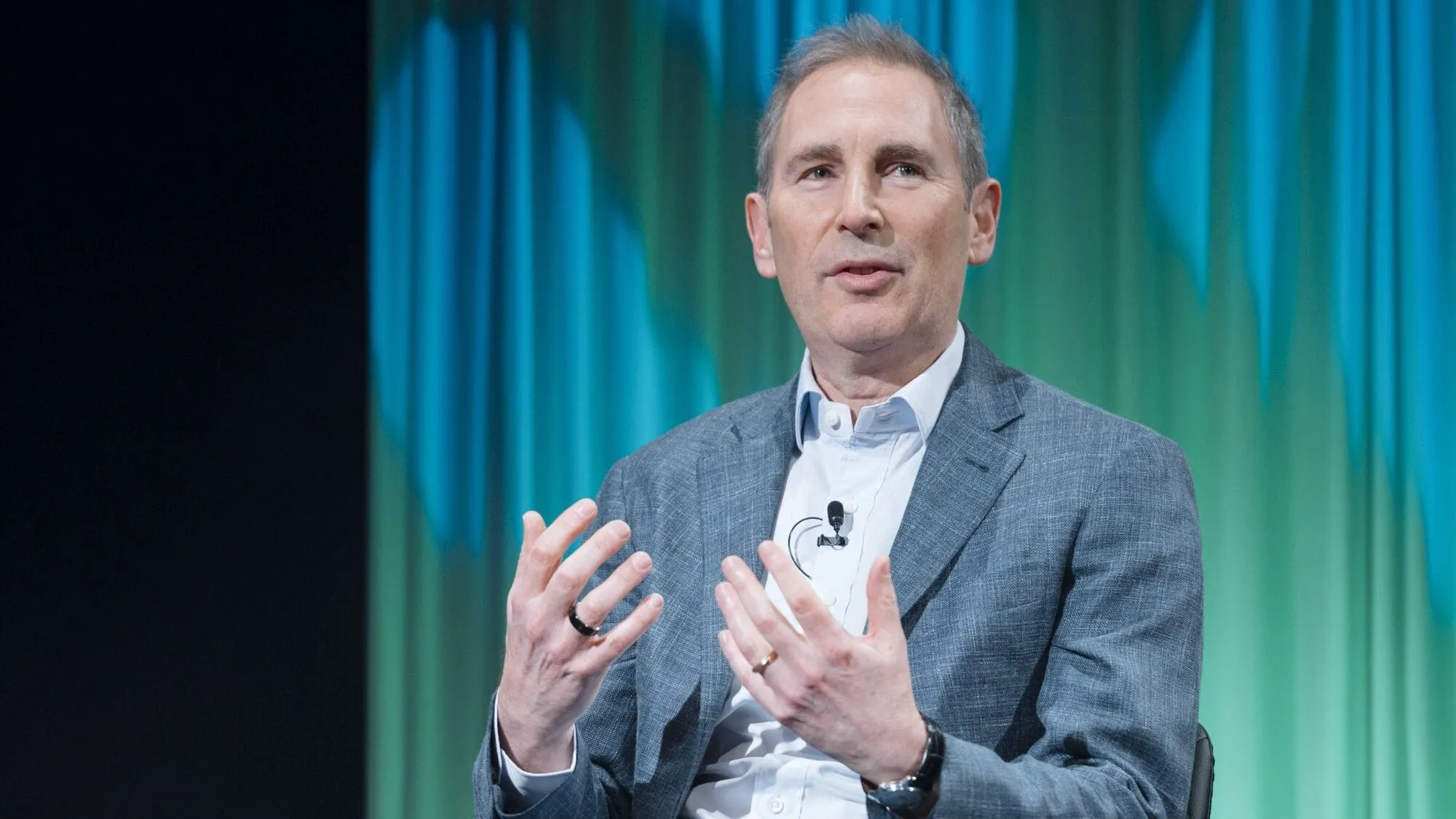

Andy Jassy thinks AWS can be a $1 trillion annual revenue company in as little as 60 months – an extraordinary projection. More on that, Amazon’s satellite ambitions, DuckDB acquisition, and eye-watering capex figures from its earnings call.
Here’s 7 key takeaways from Amazon’s Q3 2026 earnings, from The Stack.
1: AWS has a fire under it
AWS grew 39.3% to $46 billion, its fastest clip in nearly five years and sixth straight quarter of acceleration. Amazon’s hyperscale cash cow runs at $184 billion a year. When Bank of America's Justin Post said quarter-on-quarter growth had cooled, Jassy wasn't having it: 39.3% growth on that base, he said politely, is "quite unusual".
AWS’s backlog stands at $578 billion (that compares with Microsoft’s $677 billion and Google Cloud’s $561 billion reported this week), and Amazon is installing an AI accelerator roughly every 14 seconds, with customers "gobbling it [AI capacity] up."
Amazon’s managed AI service Bedrock is now "the fastest growing multi-billion dollar service in AWS's history", AWS has seen Fortune 500 spending on it rise nearly sevenfold, and it now serves OpenAI models alongside Kimi, GLM and SpaceXAI.
2. A $1 trillion projection, because, gigawatts…
Jassy reckons AWS can grow "north of 40%" in both 2027 and 2028, and become a trillion-dollar revenue business within five to 10 years. Back-of-a-fag-packet maths suggests it would then pass $360 billion by the end of 2028. Hitting $1 trillion by 2031 would need the same pace for three more years. That’s a bold projection.
Morgan Stanley's Brian Nowak noted that Amazon does not usually talk like this. Jassy said he was confident to make that claim based on the fact that stupendous amounts of data center capacity and power supply were getting booked years ahead, because, as he put it, "you cannot leave a gigawatt of capacity hanging around."
3. Chips to third parties? Trainium goes on sale
Revenue commitments for Graviton and Trainium are each up more than 20-fold, customers saved over $2 billion in Q3 by using Amazon silicon, and most of Bedrock already runs on Trainium, Amazon reported. In a landmark move it will start selling its Trainium chips outside AWS, starting in “late 2027” Jassy said. (Google also recently disclosed that it had started selling its TPUs and expected to ramp that up in 2027.)
4. Capex up, margins up, neoclouds down
Amazon’s cash capex hit $75.9 billion in a single quarter; mostly on AWS.
Amazon reiterated its capex target of $220 billion for 2026 and said it expects to spend "meaningfully more" in 2027. Jassy was unrepentant, even as markets reacted negatively. Spreading the spend over 25 years "might be more convenient… but that's not the world that we live in," he admitted, saying “we can fund this plan."
For now, the returns are showing. AWS booked $17.8 billion of operating income at a 38.7% margin. CFO Brian Olsavsky insisted this was "not a random output", then declined to promise it would last: AI carries notably thinner margins than core services, and memory costs are biting. Jassy used the margin question to take a swipe at the economics of upstart neocloud rivals. Neoclouds runs about 3,500 basis points worse on operating margin, he suggestedm ,saying “most of our capacity is either owned or long leased, which enjoys better operating margins than what you will find when people are mostly doing colo or neo, or a big chunk doing colo or neo.
“The fact that we are running on top of our own chip that is providing both… price performance and is more cost effective for ourselves because we own it…”
5. DuckDB gets a promotion
Amazon's purchase of DuckLabs, announced in August, was bigger than many realised. DuckDB will become the universal SQL dialect across AWS storage and analytics, Jassy said, so a query written once runs on any AWS engine.
“For the first time in analytics, customers will have zero migration or portability costs between query engines. This is a big deal, and you can imagine how it will also help agents do efficient querying as well,” Jassy told analysts on the October 29 call.
DuckLabs is a 30-strong Amsterdam shop that never took a penny of venture money, according to GeekWire. Amazon bought the team; their brainchild open-source project stays MIT-licensed under the DuckDB Foundation. The first fruit of the deal, per InfoQ, lets Aurora PostgreSQL query Iceberg and Parquet data in S3 directly.
AWS pitches DuckDB as made for AI agents, which pepper data with small exploratory queries. Snowflake and Databricks, both AWS partners and rivals, will be watching.
6. Leo is late, and Q4 pays for it
Amazon Leo, the satellite broadband network formerly known as Project Kuiper, remains "on track to begin initial service this year", Jassy said. That is a quiet retreat from the mid-2026 launch Amazon had been promising and adds to endless delays.
Light Reading counts 396 Leo broadband satellites deployed across 14 launches, against a planned first-generation constellation of 3,236. The FCC gave Amazon a two-year extension on its first deployment milestone in June, and a Blue Origin New Glenn rocket exploded during a pre-launch test in May. The delay lands on the P&L.
Olsavsky said Amazon will now start capitalising Leo's production and launch costs in Q1 next year, "later than I've been predicting". Until then, most Leo costs are expensed, which weighs on the Q4 profit guide. (Wall Street was disappointed, although Leo’s delay was a small part of that: Amazon’s EPS of $1.89 fell short of the $1.96 consensus; shares slid after the bell. As ever, the capex bill did the damage…)
7. More robots, cheaper parcels
Amazon doubled its fleet of robotic arms such as Cardinal and Sparrow this year, now runs more than a million robots overall, and is building robotics foundation models “that enable faster programming and teach robots increasingly complex physical tasks, with the goal of delivering useful robotics at scale,” CFO Brian Olsavsky said.
Its new same-day sites are "very heavy on robotics" he added, and Jassy fancies robots helping with "the last 100 yards" as well. (Where will all the jobs go?)
Arms remain a small slice of the fleet.
Amazon Robotics chief Scott Dresser has put their number in the single-digit thousands, per Ars Technica. (Cardinal stacks parcels of up to 50lb, Sparrow picks single items, and its touch-sensing Vulcan can handle about 75% of item types.)
Jassy summed up that bullish AWS outlook like this: “We will always leave a fair bit of capacity available for on-demand, on EC2 or in Bedrock, and we are working closely with our customers, and they will have plenty of capacity to be able to use in AWS.
“When you do the math on the revenue and the revenue run rate we have, get you pretty quickly to escalating numbers… on top of not believing that a lot of the usage we see today is going to attenuate anytime soon, we are still really early in enterprises using inference in their production applications in a pervasive way.”