
In their defence, they did try just about everything.
Seeing the clear disadvantages of selling dumb pipes while the real value moved to higher layers in the network, telecom companies spent decades trying to climb that ladder.
They tried content, and that went about as well as you'd expect. They tried to become enterprise technology companies, only to discover that everyone from IBM to Accenture was, on average, not too bad at various bits of that business.
They built and operated data centres, only to discover the sheer scale of the hyperscalers made it hard to compete, and that selling out to colocation and infrastructure specialists – with hyperscalar customers – made more sense. Meanwhile, they sought greater scale themselves; in late June, Verizon and BT announced a 50-50 JV to combine their international operations.
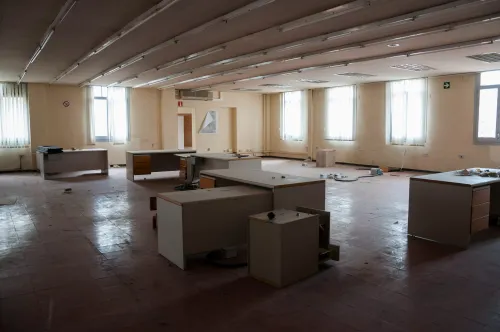
But the old-school operators may have one more trick up their sleeves: a whole bunch of nondescript buildings full of networking equipment just begging for new purpose, right as demand for inference at the edge burgeons.
And it looks like they're going to be grabbing the opportunity.
Copper is dead, long live exchanges
This is the "final year of the legacy landline network," BT told investors in July, in line with the UK government expectation that Britain will enter 2027 copper-free.
Across the pond, copper is ebbing more slowly, but there too it is being pulled out of the thousands of local exchanges and central offices that were once crucial to its switching.
The optical networking equipment replacing it is vastly more efficient by every metric, including footprint. Putting that space to work for AI inference is already happening, Verizon CEO Dan Schulman told analysts during the company's most recent earnings call, suggesting that a $1 billion deal for Google to use its fibre is just the beginning.
"We are also in the early stages of retrofitting many of our central offices into data centers for inference edge computing, with multiple conversations underway with partners who are eager to utilize these power-ready and permitted locations," said Schulman. "We are moving quickly to expand our TAM in the rapidly growing AI infrastructure market."
This strategy, he promised, will offer "a meaningful incremental leg of growth for Verizon."
BT (which did not respond to questions from The Stack) has never yet been as explicit about its plans. As of its last annual report, it is still considering "the disposal, repurposing or subleasing of properties retained post-2031,” the end of its current planning cycle.
As recently as 2023, BT was talking about "dialling-down" the number of exchanges it operates from some 5,600 to as few as 1,000. By 2025 it was talking about edge data centres, though not with any clear urgency.
Exchange rates
As Verizon tells it, that kind of infrastructure is better than gold in the current market. Exchanges need no planning permission from local authorities, all are already connected to the grid (often redundantly) and to backbone networks. They are overwhelmingly located in population centres, they're typically easy to cool, and more often than not they're quite secure.
They are not, however, anywhere near as big as the AI-centric data centres the hyperscalers are building. At the point where technological and regulatory demands meet, though, that may not matter.
"As AI moves from training into production inference, enterprises will need architectures that account for latency, data gravity, privacy, resiliency and sovereignty," Kevin Wollenweber, SVP/GM, Data Center and Internet Infrastructure at Cisco, told The Stack.
"Many companies, especially in regulated or data-sensitive industries, will not be able to send every workload or dataset to a distant public cloud; they will need compute closer to where data is created and governed."
Beyond their other advantages, Wollenweber notes, telecom operators have trusted customer relationships with big enterprises, and the kind of operational scale that startups will take a long time to build.
That could make them into ideal providers of "secure inference points of presence" that can still plug into broader cloud and model ecosystems.
Cisco has reason to hope that demand for edge inference (and the associated networking gear) will grow fast. Independent analysts are loath to project too far into the future at the granular level of AI demand, preferring to speak about the broad market instead.
Still, the total capital required to retrofit old exchanges is tiny relative to the overall AI buildout, and for once the telecom companies may be playing to their own strengths in infrastructure, and proximity to customers, rather than trying to imitate systems integrators or content players.
The big problem for the telecom operators may be that the major cloud providers are not ignoring the market for local points of presence, and started building them out well before the AI boom. AWS lists more than 750 CloudFront edge locations, plus another 1,140 embedded points of presence inside ISP networks. Microsoft Azure advertises more than 190 metro POPs. Google Cloud says it has more than 200 locations to connect to.
Those sites are intended for caching and interconnection, and are not necessarily compute-capable, but unlike the telecom operators, the reach is already global.