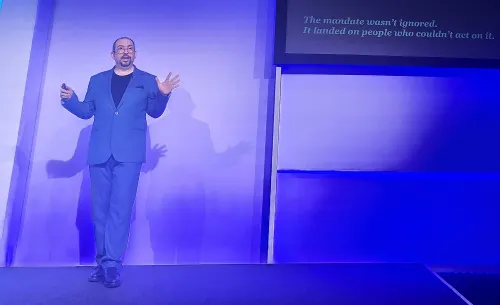
Running cybersecurity for the world’s most successful military alliance is not for the faint hearted; there’s a target on NATO’s back and powerful adversaries are sniping at it. Mario Beccia stays focused through martial arts, music, and spending time with family.
Mental clarity is vital: He’s grappling with a set of challenges familiar to many enterprise CISOs, as his teams battle to keep NATO’s enterprise technology systems secure. Balancing innovation with security, modernising identity management and cryptography across a complex landscape, and communicating complex technical issues upstream to multiple stakeholders; many of whom are well-versed in kinetic conflict, but less so in its digital counterpart.
Mario is NATO’s Cyber Readiness and Operations Director, Cyber and Digital Transformation Division; a long title that also comes with a long list of hard-won responsibilities. (It’s arguably simpler to think in four letters: Over the past five years the Italian national has been working as Deputy CIO, Cybersecurity; effectively holding a CISO role for NATO’s enterprise IT systems, which serve some 30,000 alliance users.) He joined The Stack to talk us through his main pain points and priorities.
It has been nine years since NATO recognised cybersecurity as a domain of operations; far fewer since it started trying to bring some central coordination to its own cybersecurity and broader IT functions. (In 2021, for example, the multinational defence alliance hired its first CIO, with a mandate to deliver “coherence” across its 57 civil and military bodies.)
It is now restructuring how it delivers technology modernisation, and critically, supports cybersecurity – including via a new NATO Integrated Cyber Defence Centre (NICC) that its leaders announced in 2024.
NATO’s CROD, CDTD.
Beccia, an experienced enterprise architect rejoined NATO in early 2021, after three years as CISO of the European Defence Agency (EDA), where he helped build out a greenfield cybersecurity practice at the agency. (At NATO he has previously managed a range of key cybersecurity programs and enterprise architecture initiatives, including at NATO Communications and Information Agency and NATO Allied Command Transformation.)
Sitting down to chat with The Stack in Brussels, he’s happy to reflect on some of the hard-won successes of the past four years, including efforts to dramatically streamline technology procurement, but is also candid on the challenges that remain, as the alliance continues to prioritise more joined-up thinking among its members.