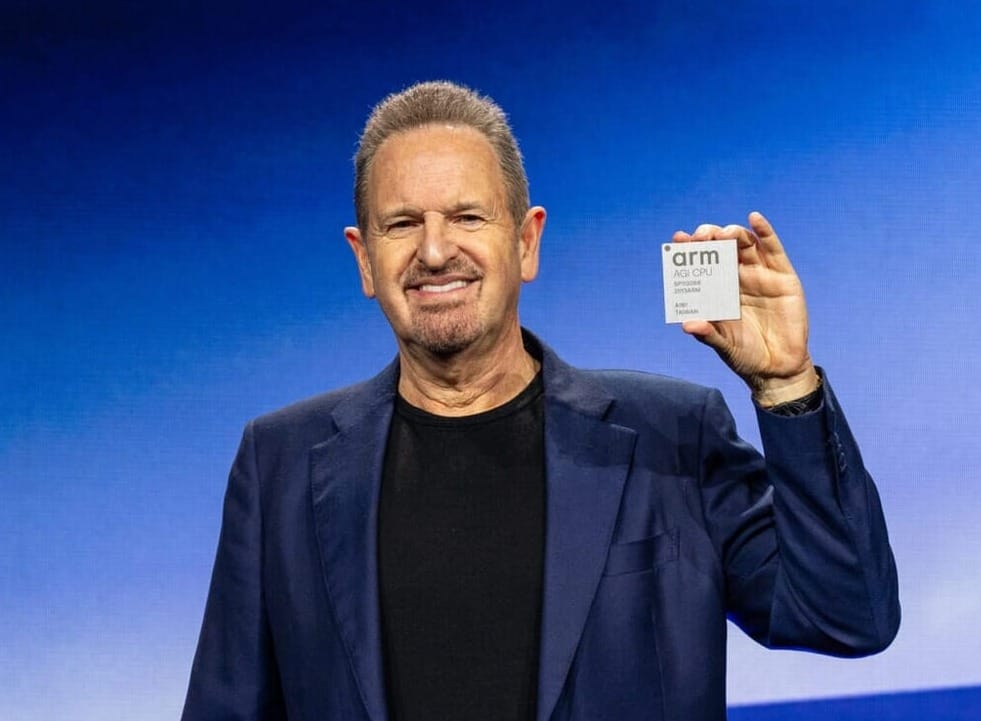
Arm believes agentic workloads will need more CPUs and is confident enough its going all in with an in-house processor for the first time.
With the announcement of its Arm AGI CPU on Tuesday, the company broke its 35-year-long history of never having released their own production silicon product.
It appears the CPU demand created by agentic AI is simply too good an opportunity to miss out on. Designed in collaboration with Meta and sold directly from Arm, the IP licensing company is making a play for hardware-level revenues.
"Every element of the Arm AGI CPU – from operating frequency to memory and I/O architecture – has been designed to support massively parallel, high-performance agentic workloads in a densely populated rack deployment," Arm's Executive VP of Cloud AI Mohamed Awad said in the press release.
Signal65 founder Ryan Shrout said via a post on X, “This is a very big deal for Arm, and for the technology markets as a new player has entered the game officially.”
Arm joins the growing pool of companies fabbing their own custom silicon, with Microsoft, Google, Amazon and Meta working on proprietary AI accelerators. Arm will manufacture the CPUs at TSMC, like most other fabless AI chip makers.
Thanks to agentic AI, the market for classic CPUs is booming as well. AMD CEO Lisa Su said in early March customers were telling her they’d under forecasted the CPU needs for AI, and AMD was “in the process of catching up” with demand.
Jensen Huang in particular can’t be too happy about Arm’s announcement as it comes a week after NVIDIA announced its Vera CPU, purpose built for… agentic AI.
Agentic AI has resurrected the CPU
Arm’s business model for the past 35 years has been selling licensed semiconductor IP. Enterprise customers take it, tweak it, and fab it using third-party foundries.
Using this model, Arm has shipped 350 billion chips via its partners, according to CEO Rene Haas speaking at the Arm Everywhere conference on Tuesday.
Haas told the audience there was one point the industry though CPUs, the chips that serve traditional cloud queries, were dead. However, agentic workloads have quashed that theory.
Haas said Arm estimates the number of CPUs needed to power agentic workflows will rise from 30 million CPU cores per gigawatt in a data centre (there can be multiple cores per CPU processor) to 120 million CPU cores per gigawatt.
This 4X increase is because AI agents can work faster and longer than humans. 24/7 queries into the cloud against LLM APIs need CPUs to translate that data to accelerators. Haas gave the analogy that GPUs may be the dump truck, but you still need CPUs to shovel in the dirt.
He said during the keynote: “We’re trying to put four times that CPU cores in that same power envelope. Power is precious, obviously the capital required for that power is precious.”
“So trying to put all those CPUs in a data centre already stuffed to the brim with GPUs and accelerators and CPUs doing the core work, that is a problem.” Haas says Arm’s new energy efficient AGI CPU will solve that problem.
What’s under the hood
The AGI CPU is designed specifically for high throughput with low power requirements. The chip has 136 Arm Neoverse V3 cores per CPU with 6GB/s memory bandwidth per core.
It also “supports air-cooled deployments with up to 8,160 cores per rack, and liquid-cooled systems delivering 45,000+ cores per rack.”
Arm claims the chip “delivers more than 2x performance per rack versus x86 CPUs” which could translate into as much as $10 billion in capital expenditure savings per gigawatt of capacity in a customer’s AI data centre.
Cerebras, Cloudflare, F5, OpenAI, Positron, Rebellions, SAP, and SK Telecom have all committed to using Arm’s debut silicon, alongside the CPU’s co-developer Meta, according to the press statement.
More reaction and detail to follow.
Views on Arm's move? Pop us an email.
The link has been copied!