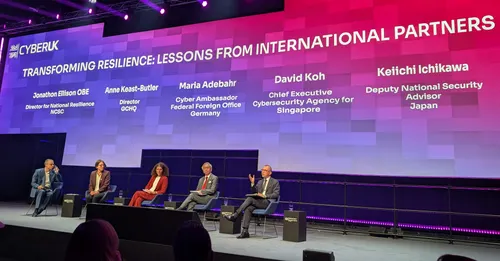

British signals intelligence and cybersecurity agency GCHQ has “developed the blueprint for a new national cyber defence capability” in recent months that “will hardwire cutting-edge agentic AI” into national defences.
That’s according to GCHQ Director Anne Butler-Keast in a landmark public speech today that spanned technology sovereignty, space capabilities, and the 80th anniversary of an intelligence sharing partnership with the US’s NSA.
Keast, who has been in the role for three years, gave few details on the proposed blueprint and GCHQ had not responded to our email as we published (although we hope to share more details in the near future.)
But its sister agency the NCSC has been public about a range of national cyber-interventions it takes, including active scanning of millions of ports, running honeypots, and its Active Cyber Defence services.
“We need businesses to take immediate action”
Keast-Butler also issued a clarion call for action from business leaders.
“Cyber security has never been more important. That message may sound familiar – the NCSC is now ten years old, after all – but I’m now saying it with utmost urgency… Cybersecurity is a critical priority for all businesses. We need businesses to take immediate action now.”
(GCHQ itself was looking for a CISO on a £90,000 salary in February.)

Keast-Butler, the first woman to lead GCHQ, was appointed in 2023. She was previously Deputy Director General of domestic security agency MI5.
“The ground beneath our feet is shifting, and shifting fast,” as AI capabilities evolve at blistering pace she said.
“When it comes to technology and data, there’s a narrowing window for the UK and our allies to stay ahead,” said Butler-Keast, in the first of a planned series of annual lectures at Bletchley Park on May 27.
Tech sovereignty
Talking about tech sovereignty, GCHQ’s Director said bluntly that “the days of state-owned supercomputers like Colossus are long gone.
“We live in a fast-changing world of big tech dominance and pervasive Chinese technology. .. For me, tech sovereignty is about the agency, ability and agility of nations to shape their own digital future.
“Sovereignty doesn’t have to mean “made in the UK”, so long as we carefully manage our supply chains, dependencies, and data.”
Amid an increasingly fractious relationship at the political level between the US and UK, she hailed the the 80th anniversary of GCHQ’s intelligence sharing partnership, UKUSA, with the US’s NSA.
It is a “powerful and robust partnership that remains fundamental for the security of both our countries,” she said, highlighting ongoing shared work in cryptography – but pointedly adding that “our strategic intelligence relationships with European partners continue to deepen.”