Blackstone and Google are building a new AI cloud firm called TPU Co.
On May 19 the two announced the joint venture to build up and lease data center capacity underpinned by Google’s Tensor Processing Units (“TPUs”).
Now Google and Blackstone are building a leadership team for TPU Co.
The two have published job openings for a Chief Operating Officer and a Chief Technical Officer. The two will “own the technical stack” and the “entire corporate and business infrastructure of the company” respectively.
What is TPU Co.?
The two revealed plans for the joint venture on May 19, 2026.
Blackstone is investing $5 billion in equity capital and plans to take 500 MW of capacity live in 2027. It expects to scale TPU Co. “significantly over time.”
The two earlier said that they anticipate the company (to be led by Google veteran Ben Treynor Sloss) to serve “hyperscalers, frontier AI labs, sovereign customers, and other leading enterprises and AI technology companies.”
Who is Benjamin Treynor Sloss?
Sloss founded the Site Reliability Engineering function at Google and as an engineering VP led its global networking backbone and data centre ops.
More recently he led TPU commercialisation as Chief Programs Officer.
Now he’s looking to build TPU Co.’s leadership bench.
TPU Co.: Who wants to be the CTO?
The TPU Co. CTO will be responsible for three critical core functions, a late June job description showed. That’s Site Reliability Engineering (SRE); hardware operations; and also software platform and operations.
That’s a lot of hats.
Sharing the Chief Technical Officer job description on June 27, Sloss wrote: “Q: SRE, Software Development, Networking, *and* Hardware operations??
“Really? A: Yes. Our customers don't care about our org chart, they want the entire stack to be flawless. I'm just putting Conway's Law to work here.”
He added on LinkedIn: “There aren't many people who are passionate about each and every one of these diverse domains, but if you are... let's talk.”
The role is an on-site one in Palo Alto. A salary range was not disclosed.
Applicants can expect it to be generous for the right person.
Avoiding a “pathology”
In an earlier conversation about SRE capabilities at Google, Sloss explained on a corporate blog how he looked for a complementary set of skills across network engineering, Unix system administration and software capabilities.
“We've held that hiring bar constant through the years, even at times when it's been very hard to find people” – that has created “a team of people who fundamentally will not accept doing things over and over by hand.”
(In an interesting aside, Sloss added: “One of the things you normally see in operations roles as opposed to engineering roles is that there's a chasm not only with respect to duty, but also of background and of vocabulary, and eventually, of respect. This, to me, is a pathology.")
TPU Co. COO
The COO job description, published on June 23, suggests that TPU Co. is looking to build the new corporate entity from the ground-up at pace.
It wants someone who can own all “business infrastructure standup: stand up all G&A functions (HR, Finance, IT, Facilities, Procurement) from scratch.”
They will need to bring in “third-party subcontractors (PEO for HR, MSP for IT, outsourced partners for Finance & Operations)” to start with and migrate “to an agentic AI-first corporate architecture over time,” it said.
They will also need to “select, onboard, and manage the full ecosystem of third-party vendors and subcontractors to power the company…”
Can it do it fast?
There is clearly a lot of work to do if TPU Co. is going to get 500MW-worth of entirely new cloud capacity online by 2027, particularly in a market already heavily constrained by chip shortages and competition for power.
Google had first started to meaningfully point to plans to sell its TPUs to customers outside of its own data centers earlier this year – and suggested capital markets firms and frontier AI labs were likely to be the big customers.
Speaking on Google owner Alphabet’s Q1 earnings call in April 2026, CEO Sundar Pichai said: “As TPU demand grows from AI labs, capital markets firms and high-performance computing applications will begin to deliver TPUs to a select group of customers in their own data centers in the hardware configuration to expand our addressable market opportunity.”
The company expects “a small percent” of TPU hardware sales to show up as revenue later this year and the bulk to be “realized as revenue in 2027.”
Google’s TPU roadmap
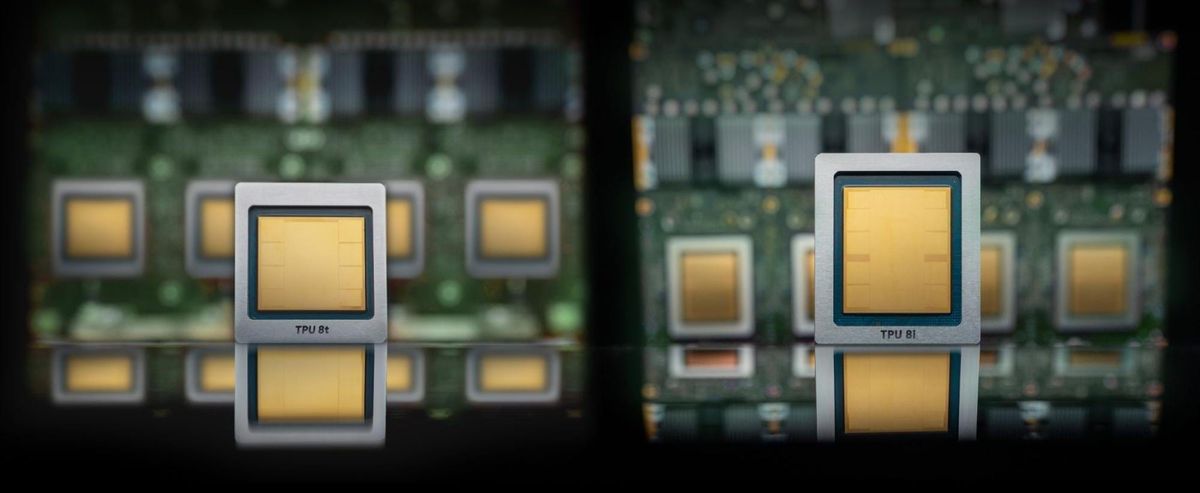
Google is currently shipping its eighth generation of TPU, or custom accelerator. (It has four core design partners. TSMC fabricates the chips.)
Writing about its latest TPU 8t and TPU 8i in April, Google distinguished engineer Diwakar Gupta and product lead Sabastian Mugazambi said that using the JAX Python library and Pathways orchestration system it can now scale to more than one million TPU chips in a single training cluster.
Its data centre fabric Virgo Network meanwhile can let it link “over 134,000 TPU 8t chips with up to 47 petabits/sec of non-blocking bi-sectional bandwidth in a single fabric. This fabric delivers over 1.7K ExaFlops with near-linear scaling performance,” the two boasted in an April 22 blog.
That’s the kind of hardware, software, and orchestration skillset it’s looking to deliver via TPU Co. too. Now it just has to source the right talent and the hardware – without cannibalising an already at-capacity Google Cloud.
Thanks for reading. New to The Stack? We're a bootstrapped, editorially-led tech publication. We try to keep as much of our editorial free as possible. Some is paywalled. Subscribing gets you access to that, a 50% discount on event tickets, and supports independent journalism. It's £250/$330 a year.
The link has been copied!