

A Google moonshot spin-off called Taara plans to create urban data highways made out of nothing but light: optics, untethered from the fibre.
The Google X moonshot factory spun out Taara in March 2025. Series X Capital now backs the company; Alphabet retains a minority share.
On February 23 it showcased Taara Photonics, “the world’s first wireless communication platform based on optical phased arrays” – along with a new product based on this photonic core, which it has dubbed Taara Beam.
CEO Mahesh Krishnaswamy told The Stack that he expects the company to begin its first deployments later this year; private early access is open now.
Google laser internet shenanigans
The product builds on work conducted for Google’s now defunct “Project Loom”– which aimed to create a network of high-altitude balloons that could deliver Internet access to remote corners of the world using lasers.
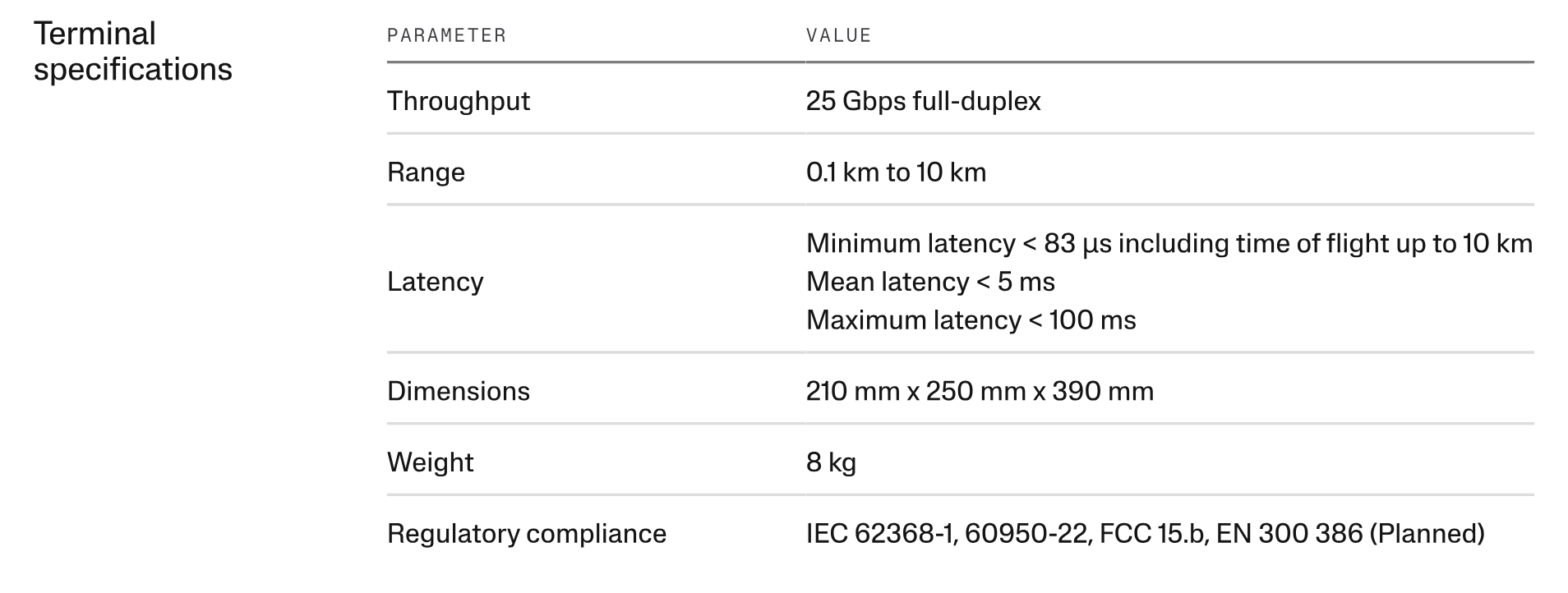
Taara said that Taara Beam transmits data “wirelessly with Class 1M eye-safe lasers in the unlicensed infrared band (193 THz)” and can support speeds of up to 25 Gbps – claimed range is 100 meters to 10 kilometers.
Its “Lightbridge Pro” option can do double that distance.
Beam, a newer product, is lighter weight at 8kg vs 13kg, and significantly smaller than the previously announced Lightbridge, which is the size of a traffic light – and which Taara says has already been deployed by Airtel, Digicel, T-Mobile, SoftBank, and Liquid in over 20 countries.
Taara Beam can be mounted to a mast or a building, and will ship with “two optical SFP+ ports, each configurable to 25/10/5/2.5/1 GbE ” along with “two 1G RJ-45 Ethernet ports,’ a product sheet showed.
Taara teased the smaller Beam device last year, after saying that it had developed a new chip to support it. The system uses “mirrors, sensors, precision optics, and smart software to mechanically align the beam to exactly where it needs to be…” said CEO Krishnaswamy.
The new chip allowed it to remove “many of the mechanical components and design[ed] a solid-state solution for automatic beam steering…”
“One of the most significant advantages of Taara’s technology is that it operates in the unlicensed optical spectrum, where there is abundant capacity and signals are less prone to interference,” Krishnaswamy told us.
Free-space optics ftw
Leftfield innovations from odd corners of Big Tech are not unusual: See Microsoft’s efforts to store data in quartz glass, or synthetic DNA.
And free-space optics (FSO) are not new; from Airbus to Qinetiq, military-focused deployments are also being explored and tested. Space has been a particular area of research focus: As one recent paper notes, that's because they increasingly generate "volumes of scientific telemetry that far exceed the capacity of today's manually scheduled, RF-based deep-space infrastructure. Free-space optical (FSO) communications promise orders of magnitude higher throughput..."
Google, meanwhile, continues to retain an interest in FSO too.
In November 2025, a team of its researchers proposed creating "a scalable compute system for machine learning in space, using fleets of satellites equipped with solar arrays, inter-satellite links using free-space optics, and Google tensor processing unit (TPU) accelerator chips," adding that "to facilitate high-bandwidth, low-latency inter-satellite communication,the satellites would be flown in close proximity..."
But Taara thinks it can really take the technology to city-level too.
(Pressed by The Stack for a technical whitepaper, rather than some shiny marketing PDFs, we were promised that a technical paper on its optical phased array technology will be presented at the Optical Fiber Conference in Los Angeles in March. You want to read it too? Stay tuned.)
“At its core is an integrated photonic module containing over a thousand miniature light emitters arranged in an optical phased array, a solid-state steering device. This phased array allows Taara Beam to track, shape, and steer light with greater precision, improving reliability and latency while significantly reducing size and mechanical complexity,” Taara said.
“Silicon photonics allows us to integrate the core functionalities of wireless optical communication into a single module,” added Devin Brinkley, SVP of Engineering in a press release. “We’ve compressed most of the functionality of our previous systems into a photonic module the size of a finger…”
We’ll be going much deeper into this next month!
Make sure you're subscribed to get the feature.
Want to comment? Get in touch.