MIAMI — Among the dozens of technology categories that have seen incredible advancements in recent years, cameras might rise to the top. The tiny, blurry digital images of a decade ago have been replaced by cinematic quality video, and thanks to breakthroughs in chips and power consumption, there are few places that cameras can't go in service of protecting corporate assets.
But all the video generated by those near-ubiquitous cameras on office buildings, factory floors, and public transportation tends to collect into a big pile of unstructured data. What was once a siloed part of a tech stack is quickly becoming just another data type for CIOs to manage.
Verkada has been building toward this moment since it was founded a decade ago to connect physical security systems to the internet, and it is now valued at $5.8 billion after raising a total of $835.5 million over the years. Revenue has soared over the last five years as customers start to understand how they can move their video surveillance systems out of basement conference rooms stocked with monitors and into the cloud, where that data can be easily accessed, augmented, and studied.
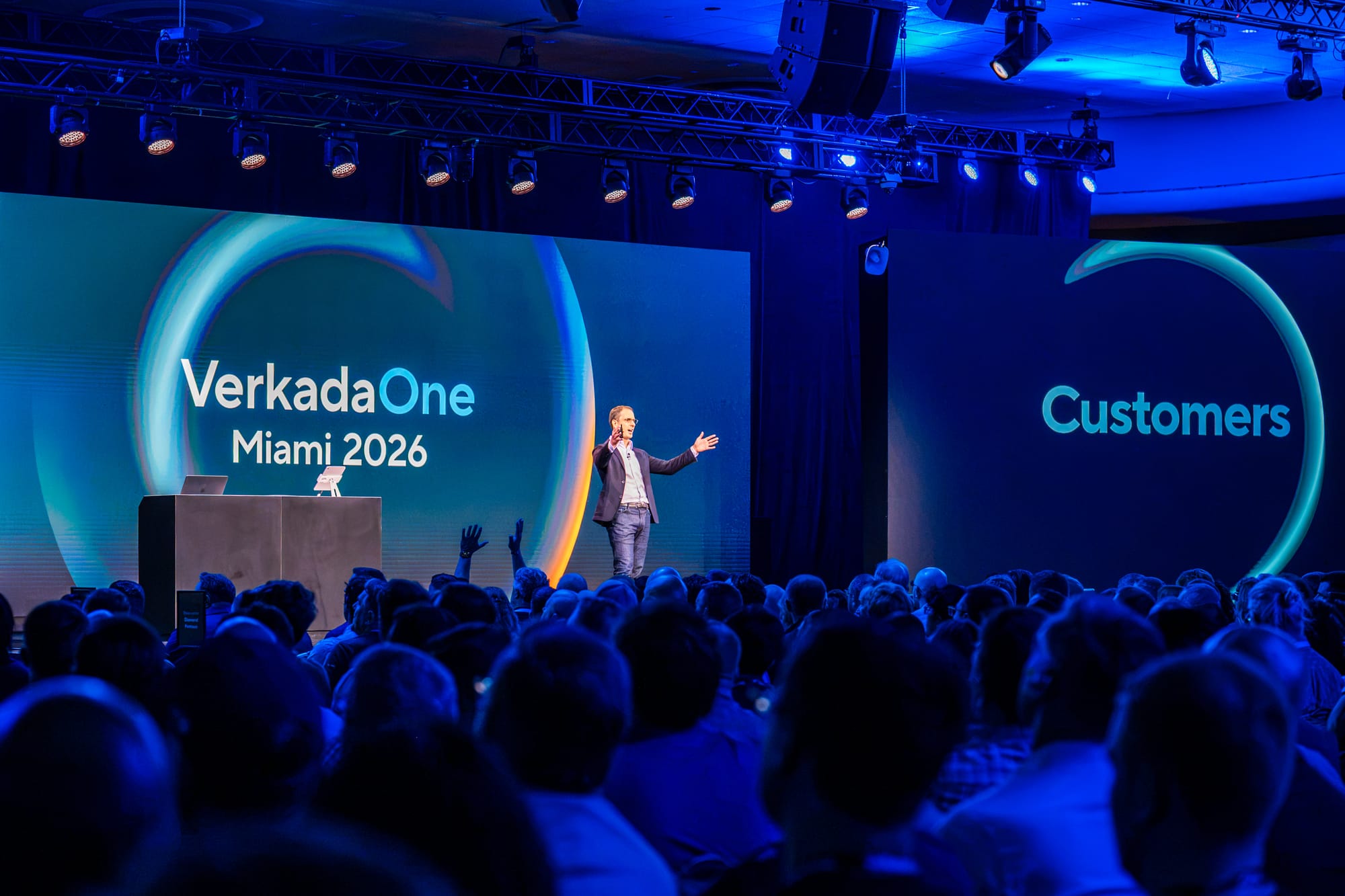
"Bringing physical security into the cloud, and bringing physical security perhaps more importantly into the era of artificial intelligence, offers tremendous progress for the whole industry," said Filip Kaliszan, co-founder and CEO of Verkada, during his keynote address at VerkadaOne last week.
More than 3,000 attendees packed into the Fountainbleau Hotel in Miami Beach to hear the company's plans for the future, which include helping customers understand how to apply AI video models to their data while navigating a growing list of privacy laws and regulations across countries and US states.
"We're now in the era of physical AI; artificial intelligence that can act in the real world, that can understand the real world," Kaliszan said. "That also has a profound impact to come in our industry."
Origin story
Verkada was founded in 2016, when software was still working through the first courses of the menu.
At that time, "the [enterprise] market lagged behind the progress seen in the consumer space, where someone could buy high-end cameras with cloud-based software to protect their home," Kaliszan said in an interview in 2020, shortly after the company raised $80 million in Series C funding. In other words, corporate security teams were still buying camera equipment based on hardware specs and managing their video on tape or disk drives shoved into a cabinet.
"Cloud is the highest growth vector, not just for Verkada, but for the whole of the physical security industry."
Fast forward ten years, and "cloud is the highest growth vector, not just for Verkada, but for the whole of the physical security industry," Kaliszan said at VerkadaOne. Verkada now manages 2.5 million devices across its customer base, and has 33,000 customers.
In an interview at VerkadaOne, Sameer Istafa, CTO of the Miami Dolphins, told The Stack that the team's security operation — which is also responsible for monitoring concerts and other events at Hard Rock Stadium — was running on-premises servers on VMware until about a year ago, after Broadcom's decision to hike prices following its acquisition of the company prompted them to look in other directions. They also wanted to be able to manage the system from the road on phones and mobile devices.
The Dolphins began the switch to Verkada in anticipation of this summer's World Cup matches, and after getting the system up and running it found that it was able to add 200 more cameras to the stadium to capture dead spots it was previously unable to cover, Istafa said. Managing that extra activity was easier than expected: "Verkada offered the cameras, access control, intercom system, and biometrics all within one system," he said.
While company executives were careful not to make a direct comparison themselves, Verkada is clearly pursuing a riff on Apple's famous dictum that a system works better when both the hardware and software are designed together. Software was an afterthought in the early days of the access-control market, but people are starting to understand the value of software that ties a complex system together.
"I think there's this perception that Verkada is a closed system, [and] that started early on because we were cloud-based," said Oscar Popravka, head of integrations for the company, in an interview with The Stack. But customers can use third-party cameras with its software, allowing companies to keep their existing investments in camera networks while still tapping into the more advanced software features.
Now the goal is to allow customers to build their own customizations and design their own workflows on top of that software, which is known as Verkada Command and allows customers to manage cameras, door locks, alarms, and everything else that companies spending lots of money on physical security need to organize.
And nothing is more pressing in 2026 than AI.
Light the fuse
"We're in the middle of an AI revolution," said Martin Hunt, chief technology officer at Verkada, during the event. "It's fundamentally changing what we're capable of, making technology smarter and more powerful."
"Take our cameras; they're not just dumb recording devices, they're actively perceiving, they're seeing the world around them," Hunt said. That allows the cameras to work together with the broader system and take action when something is detected, such as delivering an audio warning to the intruder "in the black hoodie" to stay away from the security perimeter, or reminding a construction worker that they are entering a hard-hat area, according to two examples the company presented at the show.
Given those processing requirements, Verkada now takes more of a hybrid-cloud approach to its architecture in order to unlock the potential of AI models in this space, according to Babak Behzad, director of AI and engineering for the company.
"You cannot do everything in the cloud because otherwise you have to stream all the videos to the cloud, it's going to be prohibitively expensive," Behzad said in an interview with The Stack at VerkadaOne. "But you cannot also just do everything in the cameras because you don't have enough compute power, especially with the current AI models."
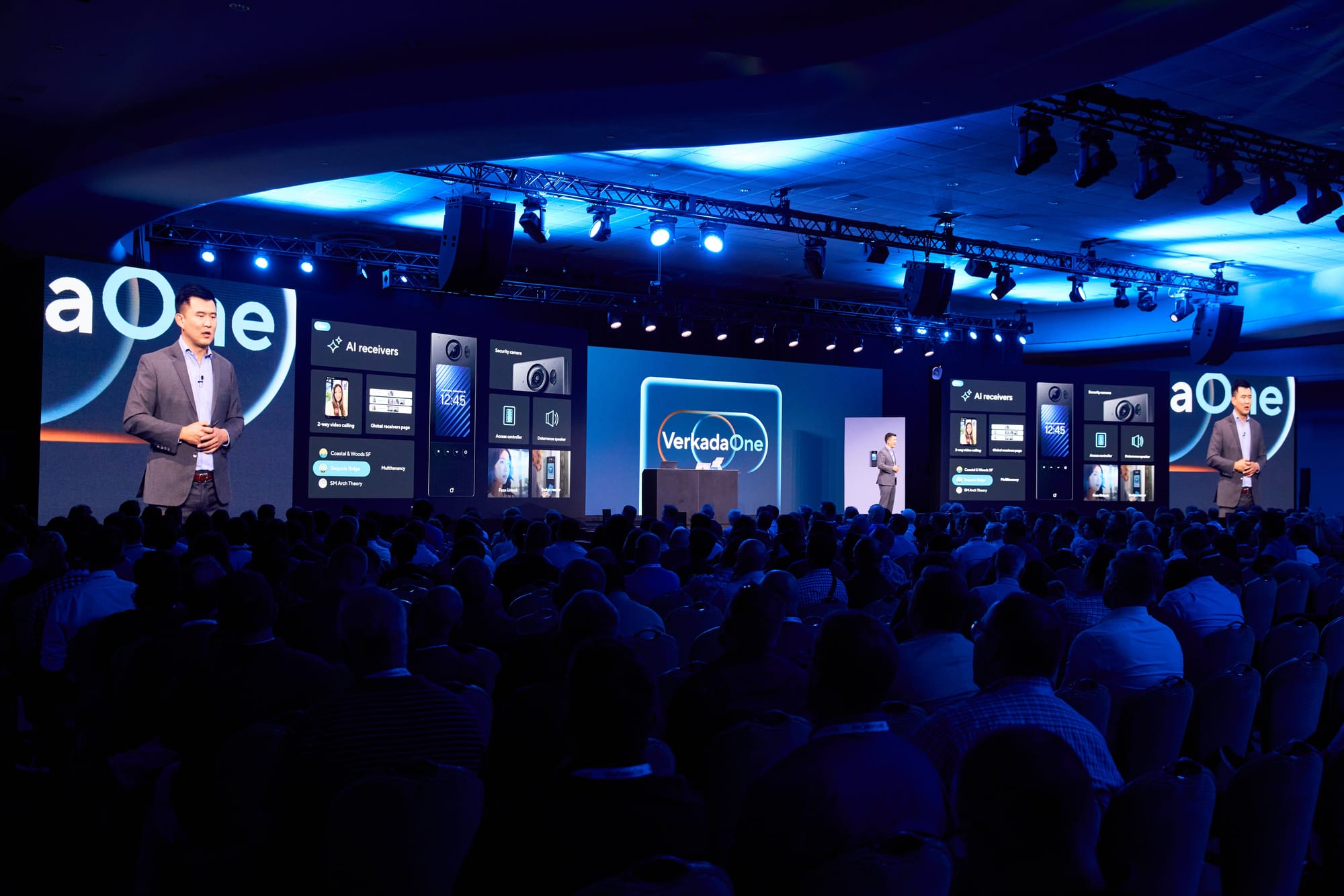
Verkada uses specialized video-learning models that it fine tunes with its particular needs in mind, and it is looking into the use of world models to help its customers build virtual models of their physical environments with even more precision, Behzad said.
But perhaps the most forward-looking service introduced at VerkadaOne was Verkada Catalyst, which allows customers to connect Verkada Command to AI agents from Anthropic and OpenAI through MCP. It's fair to say the physical security industry trails other segments of enterprise tech when it comes to embracing AI, but demand is growing, especially as companies learn they can use AI agents to automate painstaking tasks like conducting an audit of a huge camera network.
"I've always known what a good dashboard might look like, but it never made sense to go out and build it. For the first time with AI, we're seeing these kinds of things become easy and feasible for anyone to make," Hunt said.
Privacy please
Looming over everything, however, is the fact that Verkada's customers are operating complex security deployments and capturing an enormous amount of data in the process. And at the same time, those customers are trying to figure out how to manage devices across multiple states and countries that can have wildly different privacy laws in place.
As a result, Verkada incorporates privacy features, such as automatically blurring faces outside of a defined area, at the earliest stages of its product-development process, said Elizabeth Davies, chief privacy officer at Verkada, in an interview.
"Throughout pretty much every piece of technology and every piece of equipment that I come in contact with today, there's a safety consideration there that wasn't there 40 or 50 years ago, and I think the only difference is now we're seeing it in software."
"We think about privacy almost as though it were a product SKU," Davies said. "Throughout pretty much every piece of technology and every piece of equipment that I come in contact with today, there's a safety consideration there that wasn't there 40 or 50 years ago, and I think the only difference is now we're seeing it in software."
The company does this through recognizing the power of defaults, and shipping many of its new products and services with the most constrained privacy setting active. Davies described this process as the company asking itself, "how do we engineer things to be as safe as we think we can make them without necessarily sacrificing all of the utility?"
Privacy and data concerns are only going to increase as AI makes its way into parts of the world it has yet to touch, and Verkada also bears an enormous responsibility keeping customer data safe from would-be hackers who could obtain a treasure trove of corporate intelligence with a little bit of luck and skill. But Davies sees Verkada borrowing concepts from other industries as it moves forward, such as the healthcare industry's concept of "differential privacy" which involves "basically injecting enough noise into the system so that it becomes increasingly hard to trace back the source."
"We are going to continue to see privacy and security woven together," she said. "I think we're going to get better at delivering both by using more and more privacy-enhancing technologies and techniques in the platform."
Delivered in partnership with Verkada.