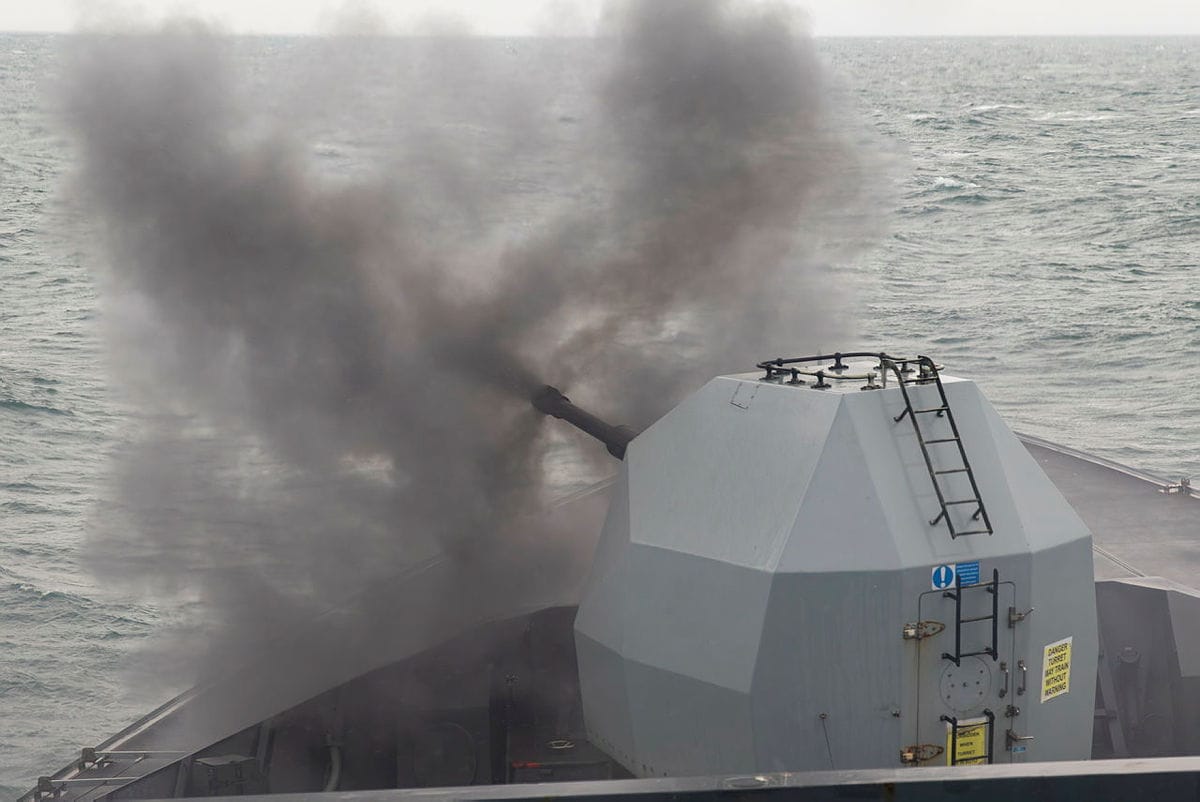
The UK’s Ministry of Defence is scrambling to buy counter-drone systems for the Royal Navy that require “no/minimal integration” from “providers that are able to work at pace” – because, strikingly, it wants “a mix of effectors both kinetic and non-kinetic to counter a mass of threats from the proliferation of uncrewed air systems (UAS)” deployable within a month.
A request for information (RFI) this month from MoD comes after two drones heading for RAF Akrotiri in Cyprus were intercepted on March 2. A day earlier, a Shahed-type one-way drone reportedly launched by Lebanese Hezbollah hit the British base. No injuries were reported as a result.
The RFI for what MoD dubs “Project TALON’ details a need for a counter-drone system with “minimal to no ship integration, [that can] operate with high autonomy, and be deployable on crewed vessels.”
“The intention is to challenge traditional Defence procurement approaches by conducting a rapid market survey through this RFI and if the project is deliverable, selecting credible solutions; contracting and delivering the initial capability within one month.” The Ministry of Defence
The pace of procurement and announcement shortly after a drone attack on British assets has left some pundits questioning why the procurement appears on the surface to be so rushed, given the threat from UAS or drones has been well documented for years; including by British military leaders.
Project TALON
Project TALON comes after hugely sophisticated and expensive aerial radar systems in Qatar, Saudi Arabia, and the UAE were reported to be badly damaged by low-cost Iranian drones in the wake of US and Israeli strikes on Tehran, with AN/TPY-2 systems hit in Iranian attacks on THAAD batteries.
As defence publication TWZ’s Joseph Trevithick and Tyler Rogoway noted this month: “Strategic air and missile architectures, in general, exist in a world now where the threats they face are not limited to very-long-range standoff capabilities possessed only by peer or near-peer adversaries.
“Long-range one-way-attack drones, as well as increasingly capable cruise and ballistic missiles, continue to proliferate steadily, including to smaller nation-state armed forces and even non-state actors. An attack could even come from a small drone with a C4 charge launched from a fishing trawler 10 miles away from one of these critical radar installations…” they wrote.
A MoD spokesperson told The Stack: “We are constantly investing in cutting-edge capabilities to defend our equipment, bases, and people.
“Our Type 45 destroyers [the UK has 6], including HMS Dragon, already possess state-of-the-art defences that are capable of engaging drone threats, including those we’re seeing in the Middle East,” they said.
“Through the groundbreaking Atlantic Bastion programme, we are leading the transformation to a hybrid navy - integrating autonomous vessels, AI-enabled sensors, warships, and aircraft to safeguard the security of our fleet. The UK is continuously investing in new counter-drone defences.”
MoD suggests that Project TALON is intended to provide additional capability to “already capable” Royal Navy platforms, with Project TALON one of two new RFIs (the other being Project METIS last month) that seek "low-cost effectors to counter the mass of threats from the proliferation of uncrewed systems to complement current Complex Missile Systems."
The RFI aims to provide modular counter-drone capabilities deployable in an agile manner across the force, consistent with the Hybrid Fleet concept, it said – an approach that avoids the need for complex mountings etc.
A Royal Navy press release on February 26 said HMS Duncan had recently engaged in an exercised in which its crew faced “attacks from swarms of surface and aerial drones moving up to 200mph, as well as virtual missiles.
“HMS Duncan and her attack helicopter from 815 Naval Air Squadron used their advanced weapons, radars and sensors to identify, track and neutralise the attacks – including firing Martlet air-to-air missiles, heavy machine guns, Phalanx Automated Gun, 30mm gun and the 4.5in naval gun,” it said.
“HMS Duncan met their overall objectives of Sharpshooter by tracking and neutralising five aerial targets,” it added – a modest definition of “swarm.”
The link has been copied!