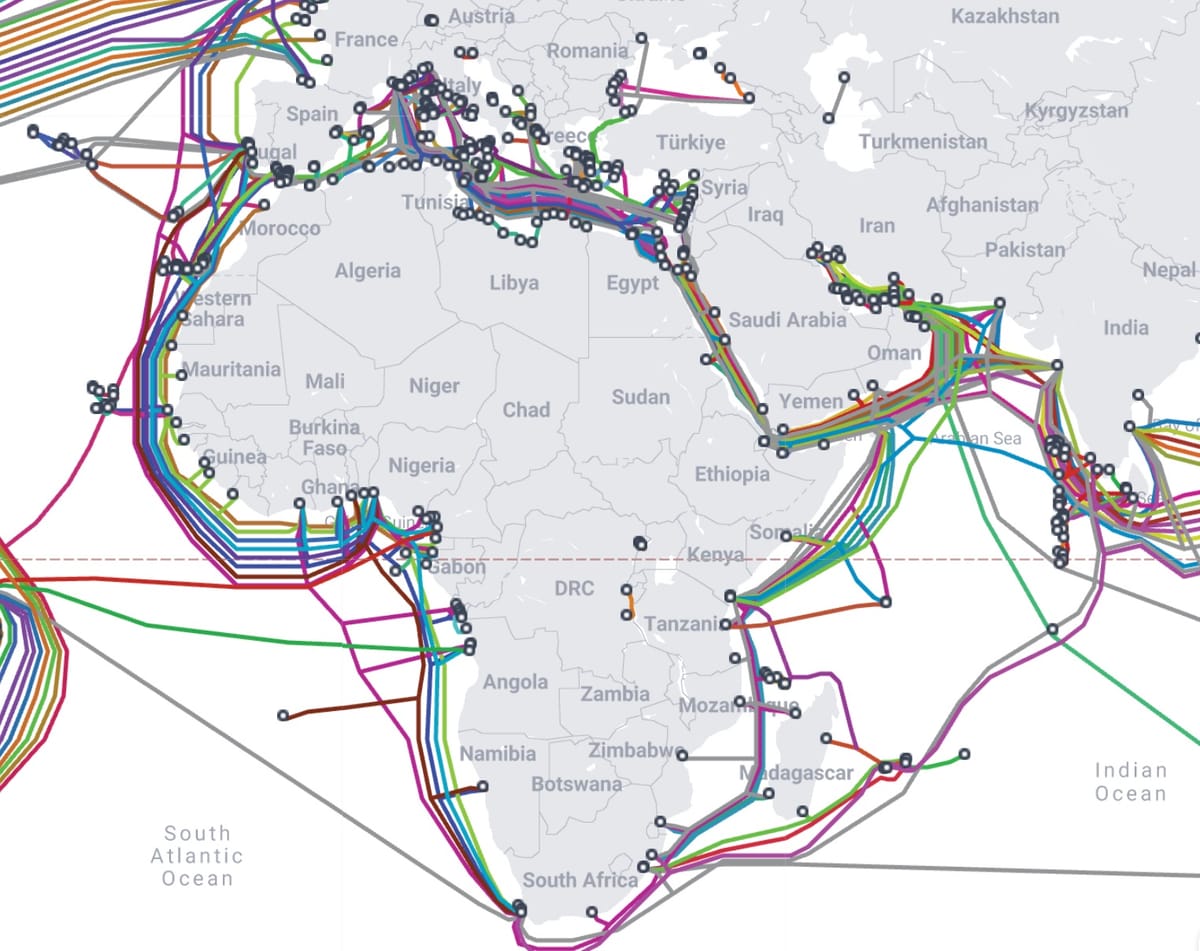
The map of key internet cables carries the story of political unrest in the Middle East.
At its narrowest point, the Strait of Hormuz is as wide as the Dover crossing between England and France, with just about 30 km of water separating Oman from Iran.
Cables enter the Persian Gulf through that strait to reach data-hungry destinations in the UAE and Kuwait, but that is where they stop. For reasons that predate much of modern internet infrastructure, there are no cables to connect Gulf states to Europe via Turkey, because that would mean traversing either Iraq or Iran.
And you'd have to be crazy to run important data that way.
That does not mean global data infrastructure is immune to a war in Iran. Already AWS has reported outages in its ME-CENTRAL-1 region in the UAE. However, impacts will probably remain isolated to local data centre disruptions.
Key communication cables in the Red Sea are within reach of Iranian proxies such as the Houthis, and could in theory be vulnerable if Iran's new leadership sought global disruption.
While data centres in peri-urban industrial parks in the Gulf benefit from missile defences, sub-sea cables are not actively protected.
But on a practical level, the risk to such cables is not much greater during the war than at any other time, maritime infrastructure experts told The Stack on Monday.
Unlike the outlook for hyperscaler data centres.