
Video
Ken Beinert is Chief Technology & Operations Officer at London Stock Exchange Group (LSEG), where he leads the development of its technical and operational architecture. The Goldman Sachs veteran joined the global markets infrastructure and data provider in summer 2025 – and is responsible for its AI transformation strategy.
The big focus? “Enabling sustainable growth and stability of our customers and their communities.” Among his tactical challenges: delivering that in an exceptionally fast-moving technology landscape – one where data discipline, innovation, and fiscal precision are all paramount. Beinert joined The Tokenomics Foundation’s Executive Director J.R. Storment to talk AI agents, economics, governance, and more.
The below is from the transcript of their conversation, lightly edited for brevity.
Q: Tell us about your AI strategy
“We think about our AI transformation strategy really in three pillars.
“The first is AI-ready data, where we're focused on making sure that our customers have access to our trusted high quality data in APIs and formats that are extremely accessible to AI. The second is transformative products where we embed AI directly into our existing products and evolve those products so that they're truly AI-native, and the third, of course, is what we call intelligent enterprise, where we're focused on enabling our internal colleagues with the right tools and practices.”
Q: When we think about AI economics, [The Tokenomics Foundation] finds that it's about the total cost of AI, because models and tokens are often a quarter of the spend. When we're talking about AI, what's included in that equation for you?”
15:31 When we think about the investment for an AI solution, I think really about it in two different phases. The first is [to…] focus on the problem that we're trying to solve, secondly on the success metrics that we'll use, the spend, the quality, the user experience are all part of defining the problem and defining the right solution.
We're not just planning for token spend. We're also planning for other infrastructure.. We're planning for data cleansing and preparation to make sure that the data is ready for AI solutions, and then of course we're also planning ahead for real-time guardrails, recurring evals, and comprehensive observability and telemetry, so that we can manage both the cost and the quality of our AI solutions over time.
Q: The Stake of Tokenomics survey showed that companies are increasingly investing in different model options [and building] governance layers in. How do you ensure that [your teams are] using the right tool for the job?
“One of the factors that I think is most key to model selection is doing comprehensive evals of a model in situ for each solution before we launch it, and then of course continuing to monitor those evals over time, and determining as new models become available, as new solutions become available, whether or not we get better outcomes, whether it is user experience, latency, or cost optimization…
Q: We've got frontier models that everybody's using. We've got open weight models. We've got SLMs. Are you using a mix of those? What does that look like?
We are using a mix of them. You can imagine quite a lot of our customer-facing solutions and our more advanced solutions do leverage frontier models, but increasingly we're finding that many of our solutions can be solved with non-frontier models, smaller models, in some cases custom models. We're beginning to see open weight models that really compete successfully with closed weight models, and that's both at the frontier level of model as well as a smaller level of model…
Q: Let's dig in a little bit about how the variability of AI models is cascading into potentially pricing model changes for you, or maybe just margin management. In the historic capex-heavy world, there was more straight predictability on how much you were going to spend. And with AI usage, both for developer productivity as well as the mission-critical AI, there's a lot less predictability. So, how are you seeing that variability cascade into how you're having to price for your customers?
I think the most important part of pricing AI-based solutions is to make sure we understand the business case upfront, and that we do very thorough evaling for quality and cost ahead of time, so we do understand the unit economics.
The second most important part of that is to bake in the right assumptions into those unit economics, so that we have the opportunity to continue to make them successful over time. Like the rest of the industry, certainly what we're seeing is that prices change very rapidly in multiple dimensions for potential AI solutions, but at the same time, what we're often seeing is that unit economics for an existing solution can improve over time, especially as newer models become available or as we tune our solutions based on our observations through our own telemetry and ongoing evals.
Overall cost, on the other hand, certainly can increase as we see customers and colleagues using those same products even more.
Q: You mentioned unit economics a few times. Is that a granular unit economic, like our cost to serve this customer, or is it a bigger concept?
The unit economics really can vary based on a specific use case. But for me, the example that comes most immediately, most accessibly to mind, is cost per task, where what we really want to understand are the typical tasks that a user uses a given AI solution for, so that we can develop the right evals for each of those tasks to measure both accuracy, quality, latency, feel and experience as well as cost.
Q: How do you enable those trade-offs between cost, value, speed, latency, and are there certain jobs or use cases where you heavily index toward one versus another?
Within LSEG, we have a number of use cases where we use AI for an input to our products, but we [also] have data preparation, data cleansing work that runs perhaps overnight and essentially is not latency sensitive, not part of the direct user experience. There, clearly we have an even greater range of models that we can select from, as opposed to use cases where a customer is engaging directly in an experience with a model. If we're talking again, 12 months from now, one problem that I'd love to see us as an industry solve is the challenge of running agents safely at scale. Today, when we select an agent platform, we're selecting solutions for identity management, entitlements, containerization, runtime infrastructure, sandboxes, and of course observability and telemetry. And each of the solutions that we could use has its own differences, its own potential gaps, which can make it quite hard to switch between platforms and between models and between providers. If we solve this problem, it will really help the industry as a whole to deliver better AI solutions.
Q: How are you driving accountability for AI spend in the firm?
“Well, first and foremost, we believe that the person who owns the P&L for the product also owns the AI spend. That aligns incentives and responsibility.
And secondly, we believe in providing central platforms and controls around AI, both for evals and cost controls, as a joint venture between enterprise AI and finance. And the reason for that is that while the accountability needs to remain with the P&L owner, centrally we have the opportunity to stay abreast of best practices and transformative AI solutions that can be rolled out across these use cases.”
Q: How does Tokenomics differ from FinOps for you?
I see AI economics really, in some ways, as an evolution of cloud FinOps, clearly it is more complex. The pace of change of model selection is much greater, with changes in new types of compute, storage, network infrastructure, etc. There's much more variability in cost, and there's just so many different dimensions of cost. For example, caching and fine tuning… These are things that FinOps didn't have to deal with!
Look, I think that the practices that we have in place for FinOps today, we're going to continue to have all those same practices. But we're going to raise the standard for how we do financial management so that it is more real-time… add an increased element of managing for user experience, because certainly what we find in AI, unlike compute, unlike storage, is that there's a much greater element of variable user
The thing that I'm most excited about is understanding the real potential of AI and putting it in place within our organization, it seems like every day there's new insights into practices that we can apply. Almost every day we're seeing new models that have capabilities in advance of what we expected, but entirely new model paradigms that enable use cases that literally did not seem feasible even a week ago.
Delivered in partnership with the Tokenomics Foundation. To learn more read the 2026 State of Tokenomics report.
LSEG CTO on AI unit economics, innovation, and P&L for tokenomics
HSBC’s Group CTO Mario Shamtani likes fast cars and track days in a Radical. It’s hard, from a distance, to know how radical he is being with his reform efforts. But it is clear from previous conversations that The Stack has had with others in the organisation, that trying to drive change fast at HSBC has sometimes been a bruising experience. Many reform-minded technologists have left after a few years, chastened and a little battle-sore. It’s hard to transform people, process, and technology at a company over 160 years old, active in 57 countries and with over $3 trillion in balance sheet assets; change-aversion is also a thing and for years the unspoken motto may as well have been “move slowly and please don’t break anything; particularly the mainframes.”
HSBC is notably more reform-minded under Group CEO George Elhedery, who took the role in September 2024. He has reorganised its global operations into four business divisions, effective January 1, 2025, and there is a renewed sense of urgency at the bank around organisational modernisation; something felt across a sprawling technology function – some 60,000 engineers – with a mix of trepidation and anticipation. New leadership abounds in many quarters, including the CTO’s office.
The Stack joined Shamtani for an exclusive first interview. We talked mainframe modernisation, streamlining container platforms, AI “boiling our brains” and more.
Group CTO Shamtani joined HSBC in 2024. He is a technologist’s technologist – and has been since his degree in computer science back in the halcyon days of Manchester in the early ‘90s. His career has taken him from Citi – where he was global head of fixed income and currencies technology – to JPMorganChase, where he was on the leadership team as head of markets technology for its Commercial Investments Bank.
Sitting down in the bank’s Canary Wharf headquarters for an exclusive interview with The Stack, and asked to summarise his priorities, Shamtani describes himself as focused on “modernising infrastructure and building an optimal hosting strategy; driving our data strategy; simplifying our data architecture; delivering value for the business; improving automation of controls; AI for tech – that means productivity of our engineering, and delivering enablement for the rest of the business in terms of all of our colleagues using AI across across their work” – and more; a sweeping mandate.
That’s a smorgasbord of entry points for a journalist. Where to start?
It’s a bank: mainframes, let’s start with the mainframes.
“Mainframes are actually cheaper…”
HSBC, like most large banks with a storied history, is a typical case of old meets new on the infrastructure side. Alongside the approximately 7,000 Kubernetes clusters, 2.4 million containers, nearly 65,000 namespaces and more than 1,900 IT services across public and private cloud, is a stubborn suite of mission-critical applications written in COBOL and other languages from Times of Lore, running on mainframes.
What’s the plan? (Plenty of organisations continue to try and get out, at great time, expense, and the sweat of semi-retired developers.) Asked if there is a bank-wide directive to Exit The Mainframe, Shamtani takes a beat: “When Stuart [Group CIO Stuart Riley, who took on the role in February 2024] first arrived here, there was a plan to do that, and he didn't believe the plan was credible and would work. So we've taken a much more incremental approach to hollow them out,” he responds.
What does that mean?
“That means take capabilities out of them that don't belong there,” he says, pointing to the need to access mainframe data and adding that “you want to sort of take some of the orchestration out… hollow it out means simplify them, take functionality out.”
“Mainframes have a purpose in terms of large… transactions. They're also cheaper to run [but] harder to change… they're tightly coupled, and therefore when you make a change, you have to understand what that affects,” HSBC’s CTO adds – suggesting (without going into further detail) that there is also an ongoing technology leadership debate at the bank around whether mainframes are, perhaps, more secure.
“Mainframe providers don't work in the same way as the software providers generally do, where they'll say to you, ‘this piece of software's out of date now. You can't use it anymore,’ Shamtani muses. “Mainframe providers don't do that. They want you to keep using them, because you have to keep paying for support…”
He is, he suggests, working closely with IBM on this (“we actually have a very good relationship with IBM”) and pressing for a more proactive approach from the world’s last mainframe-maker on which applications and systems it sees as most at need of modernisation – adding that even Big Blue struggles with skills: “If you’ve got something on an operating system that was modern 40 years ago, it's very hard to keep people around that want to work on that. Even if you're IBM.
“So, mainframe modernisation is something we're doing incrementally.
Data: People, process, and the CTO/CAIO
“Hollowing out” these mainframes is also part of a larger data priority.
There’s no good AI without good data. HSBC, with its globally scattered, architecturally diverse, range of businesses, has some work to do on this front.
Asked by The Stack what the “the stickiest and most intractable challenge” at the bank is, Shamtani says “Probably the most difficult is data, I would say, because it touches every aspect of the bank… everything gets boiled down to a data problem.”
He adds: “I think we are getting lots of traction there in terms of the way we're executing around controls and automation and risk reduction; architectural simplification and tying that into our AI enablement, and then driving business value.”
HSBC appointed its first Chief AI Officer, David Rice, on April 1, for extra muscle here.
Rice, previously COO for HSBC’s Corporate and Institutional Banking business, is an operator and HSBC veteran who knows how to move the lines of business along.
How do they work together?

Shamtani describes Rice as being focused on “deeper reimagining of business workflows… working with all of our colleagues around skills uplift; also working with regulators and the total second and third line around building the right controls and risk processes around how we think about AI at scale. My part [...] is delivering the enablement technologies, the platforms… an AI platform that starts to codify controls and codify our ability to serve different use cases; so we're sort of two-in-the-box.”)
Developers and app.hsbc
More broadly, HSBC has made progress with its infrastructure modernisation, says Shamtani, explaining: “I think we were very quick to move to the public cloud.
He is focused on putting in “much more of an optimal hosting strategy, modernising some of our internal infrastructure and going to a private cloud,” the CTO says.
What does he mean by a “much more optimal hosting strategy?” The Stack asks.
Is HSBC repatriating some cloud workloads?
Shamtani does not answer that latter question outright.
The bank is putting workloads where they most “cost-effective,” whilst being mindful of sovereignty requirements, he says. “We've done a lot of work around FinOps… work to either mature workloads in terms of being efficient, or to pivot them.”
Critically, the bank has been “pretty good” at containerising, but has “ended up with multiple container platforms; we're now merging those into a much more cohesive container environment,” he explains. It is doing that via an internal application platform called app.HSBC that brings multiple container and hosting platforms together with a common platform interface, customer API and control plane.
"A consistent paved path..."
Asked for more detail in a subsequent email exchange, he explains that “the aim is to give teams a consistent paved path from code or container through build, vulnerability scanning, change management, artefact promotion and production deployment… Rather than each team assembling its own pipeline, credentials, approval process, release evidence, observability and operational controls, teams declare what their application needs and consume a managed platform contract.
The platform is “declarative and infrastructure-agnostic,” he says.
“A team can specify requirements and constraints such as region, data residency and service levels; app.hsbc then determines how those requirements are implemented across Kubernetes, virtual machines, AWS, Google Cloud and on-premise infrastructure. The intended model is for workloads to be portable and, where appropriate, stateless, allowing the platform to optimise placement across providers.”
app.HSBC also exposes managed capabilities, including databases, queues, caches, storage, event streaming, API gateways and data ingestion, through a single console.
Its adoption moves responsibility for more of the implementation, controls and ongoing maintenance from individual teams to platform engineers.
AI for bespoke tasks
On the AI front, there has been a lot of “localised innovation” he adds. (The bank is using AI across customer service, cybersecurity, fraud detection, risk assessment and transaction monitoring, as well as to support credit analysis write-ups, it says.)
HSBC’s CTO has a central AI engineering team in his group with “strong talent” he says. “We're beginning to build capability up… we're starting to use smaller language models for very bespoke tasks, and also where we're trying to get more predictability, more control over the outcomes, and more deterministic outcomes,” he adds.
Where’s the alpha here? The Stack asks.
"The alpha is fundamentally serving our clients better… to be more trusted, to be able to serve them in the best ways possible to create the best experiences for them,” he says, adding “we do want to retain human judgment. We do want to retain trust, so it is important that we are still, innately human in how we approach our customers.”
He concludes “It can feel overwhelming when there's so much change happening.”
“Earlier this year it was boiling our brains because there was so much happening so quickly. [but] we're trying to take people on a journey with us, and particularly with AI, where people are feeling really anxious, we really care about humans being in the loop. That doesn't mean that we're not automating a lot. It doesn't mean that we're not going to use AI to create even better experiences for our customers…
“But it's a great time to be a technologist. I really believe in a brighter future.”
The Big Interview: GEICO VP, Infrastructure, Rebecca Weekly, is repatriating from the cloud and unapologetic about it
HSBC Group CTO Mario Shamtani on rationalising container platforms and "hollowing out" mainframes
For Amsterdam-based exchange Bitvavo, the speed at which its customers can trade is everything.
"Every network latency that we cut, or every request that we serve faster, means a lot of revenue, a lot of opportunities, also for our users," Bitvavo engineering leader Ibrahim El Moufti told The Stack.
"We deal with a lot with high frequency trading and market makers and low latency systems, and our systems need to serve those requests as soon as possible," he said.
And while increasing speed by milliseconds, and sometimes nanoseconds, can make a difference for its customers, like many other companies, Bitvavo wants to focus on managing its core business rather than infrastructure. The company's. requirements are a system with zero downtime and the ability to accommodate bursty spikes in traffic.
"Imagine you have a busy day in crypto," Moufti said, perhaps due to a typical Elon Musk tweet. "Suddenly we have a high spike in traffic that was unprecedented. And we want to deal with those events really fast."
A private datacenter that requires a phone call to provision more capacity would simply not cut it. So, from its earliest days, Bitvavo has been cloud-native, and that decision has proven wise in a highly cyclical market for a company that wants to iterate fast.
When there is a surge in interest, Moufti said, its system centred on Kubernetes through Amazon EKS scales automatically, and cleanly, with low operational overhead.
Cloud-native for a smooth DORA process
Bitvavo particularly appreciates Aurora's separation of compute and storage, which AWS says improves availability, failover capabilities and operational efficiency compared with self-managed database deployments. For Bitvavo, those characteristics have become increasingly important as regulatory requirements have tightened.
The company recently completed work associated with Europe's Digital Operational Resilience Act (DORA), which requires financial institutions and critical service providers to demonstrate operational resilience and disaster recovery capabilities.
Moufti said Aurora's cross-region failover capabilities significantly reduced the engineering effort required to test and demonstrate resilience. Tasks that once demanded detailed playbooks, dedicated war rooms and extensive operational preparation are now more routine, allowing teams to focus on customer-facing development rather than infrastructure management.
According to the Bitvavo engineering leader, Aurora beat out other AWS services with its low operational overhead.
"We used RDS, for example. We tried managing our own databases on EC2s. I think the reason Aurora really sticks out for us is its low operational effort… We don't want to deal with the complexity of managing databases on the cloud."
Cloud AND AI-native
The cloud-first strategy also shapes Bitvavo's approach to artificial intelligence. Like many technology companies, the exchange is attempting to move beyond AI-assisted workflows towards what Moufti described as becoming "AI-native". The goal is to mature past giving employees access to generative AI tools, to integrating AI throughout engineering, product, legal and operational processes.
One example is incident management. Bitvavo is experimenting with AI agents that can analyse logs, metrics and alerts during production incidents, helping engineers identify likely causes more quickly. Rather than rearchitecting systems around AI, Moufti said the larger challenge has been improving documentation and knowledge management so that agents can understand internal systems and processes. In practice, that has meant changing how product specifications, architectural decisions and operational knowledge are recorded.
AWS is also becoming part of that AI strategy. Bitvavo recently began using Amazon Bedrock and AWS's emerging agent tooling, attracted in part by the ability to route tasks to different models while maintaining governance controls. For a regulated financial platform, Moufti said, identity management and access controls remain as important as model performance.
This interview was delivered in partnership with AWS.

Why Bitvavo chose a cloud-native database for nanosecond latency wins
Bank of America Chief Information and Technology Officer (CTIO) Hari Gopalkrishnan has played a key role in the bank’s AI rollout since it first announced its Erica chatbot back in 2016, but, speaking to The Stack, he strikes a cautious tone when discussing the returns on AI investment.
“People are going a little crazy about, like, ‘We can use agents, and agents will call agents, and they will use tokens,’” he says during a conversation at the bank’s London office, “Before you know it, something that was a $100,000 process, you spend $1 million trying to optimize it.”
That’s not to say America’s second-largest bank, which manages some $4.9 trillion in client funds, isn’t investing heavily in AI.
After chatting with The Stack, the CTIO team sent over AI statistics outlining its 300 use cases in development, 34 of which are “fully deployed,” and 1,722 AI-focused patents registered in its name.
But Gopalkrishnan says it's easy to fall into a trap with AI, explaining, “With old technologies, you spent so much time writing code, you had plenty of time to figure out how much it was going to cost you. Because [AI] is so fast to deploy, it's very easy to get seduced into thinking ‘Let's just go full steam ahead and figure out the cost later.’”
“That doesn’t work well,” he adds.
The Big Interview: Bank of America CTIO Hari Gopalkrishnan
The Stack is resurfacing some of our favourite "Big Interviews' from 2025 as we close off the year. This piece first appeared on August 26.
BNY CIO Leigh-Ann Russell’s first job after school was in a bank. She hated it: “I had to stamp cheques every day; thousands of them. I’d get to 1,500 stamps, and then I'd forget the number, and I have to start it all again. It just wasn't my dream of how I would spend my life” she tells The Stack.
Russell grew up in a council estate in Scotland. Her dad worked a manual role during the week, and at a fish-and-chip shop at the weekends. To them, an apprenticeship in a bank sounded like white collar stability. So when she decided to go to university – the first in her family to do so – to study engineering, they were worried and taken aback, she recalls.
“I think my mom said, ‘but universities are for hippies and rich people,” she remembers with a wry laugh. But intent on blazing her own trail, she set off to Aberdeen University for a degree in engineering that changed everything. She’s now back in a bank as CIO, and this time, she’s loving it.
Leigh-Ann Russell is now Chief Information Officer of BNY, a bank that oversees $51 trillion in assets for clients and which in recent years has embarked on a major technology and organisational transformation.
BNY was created by founding father Alexander Hamilton in 1784 and became the first firm listed on the New York Stock Exchange.
“Legacy”? Just a bit, then! Whilst much of it is proud “legacy”, the bank, like every well-established financial services firm, had no shortage of ageing infrastructure and applications to clean up. Mercifully, a major overhaul had already born fruit when Russell joined in 2024, she cheerfully admits.
“We had a greenfield project which was really about massively upgrading our infrastructure and our app environment. A lot of that core work had been completed. We're 35% more energy efficient in our data centers. We're 40% more space efficient in our data centers…” she explains.
Sony turns to K8s, reveals Playstation outage cause
The cloud/on-prem split is “roughly a third of our apps sit in the cloud environment, but almost our entire landscape is cloud-ready, so that we can move from on prem to cloud at will as we choose what's right for the right application…” she adds in response to a question from The Stack.
(A few recently closed roles in BNY’s technology services group arguably give a flavour of the shift. One VP role captures a whole industry zeitgeist, seeking expertise “creating, configuring, upgrading and administering Kubernetes clusters on VMs/BareMetal… OpenShift experience is a plus… Must have experience in ArgoCD or Flux, Helm/Kustomize, Prometheus based monitoring, Ansible, Terraform and CI/CD automation”; every organisation's "digital transformation" Ted talk in a single job description!)

This modernisation effort has taken place under the leadership of Goldman Sachs veteran Robin Vince, who took over as CEO in September 2022. (Prior to the CEO role he ran the bank’s clearance and collateral management, treasury services, markets and execution services.)
BNY has been notably building out its bench under his leadership. (It also recently added Blackrock’s Carolyn Weinberg as Chief Product and Innovation Officer. Like Russell, she sits on the Executive Committee.)
“Many people across our organization are focused on innovating new capabilities, instant payments, digital assets, wealth tech, private markets, collateral, liquidity, all examples of domains where we are innovating” CEO Vince emphasised on BNY’s Q1 earnings call in April. (Weinberg will focus on “innovative new commercial opportunities and find new ways to leverage our platforms and data for client solutions…” he said on the call.)
Hacker used DeepSeek to create LangFlow exploit
On the organisational front, Vince warned that BNY was intent on making sure that it does not “repeat the problems we’ve had in the past of having everyone go off in their own direction” – resulting in siloed capabilities and platform engineers wrestling with an untidy plethora of systems.
He’s instated a platform model with group-wide functions like payments, data, treasury etc. for more horizontal innovation and simplified stacks. A quarter of employees had transitioned into the model by end-2024. BNY expects that figure to hit 80% by the end of calendar 2025, earnings show.
“AI for everyone”
BNY is keen to innovate hard with AI across those platforms, making use of its extensive datasets, and that’s one of Russell’s priorities, she says.
The idea was to aggressively democratise AI access and see what started bearing fruit when everyone got AI seeds to sow. Before that happened, the bank rolled out a group-wide AI training programme.
Some of the very first to take it were lawyers: “Our legal function [is] at 100% training completion. They have gone out [of the way] to make themselves innovative. So when they work with us on, ‘how do we keep our data safe?’ ‘How do we ensure privacy?’, every single one of our lawyers… understands what we're trying to do, and they're not blockers," she explains.
“They keep us completely within our guardrails – same with risk, same with our cyber teams – but because they've all been part of the immersion they've become real advocates and champions [for AI]. Our mantra was ‘AI for everyone, everywhere,” Russell tells The Stack. Why? "Because the best ideas don't all come from the engineering department. They come from the folks in the business who think ‘now I understand what AI is, this is how I can apply it to make things better at the bank.’
... in production
There’s an endless tidal wave of AI noise in the market and so much froth versus what is arguably just the lightest mist when it comes to ROI still.
But Russell, engineer’s hat firmly on, is a genuine convert – taking the conversation offline too after the interview – and pushes back on this characterisation: “We have more than 40 AI solutions in full production.
“They touch almost everything at the bank” she says on production deployments, citing “anomaly detection on our asset servicing platforms, trade settlements; on our Client Services team, we have a multi-agentic solution; these are delivering real value in dollar terms and productivity terms. I would say that scale [of deployment] is pretty unique…”
Pushed on the tracking of ROI she’s quick to respond and her view is arguably counterintuitive: “I think many organizations that I talk to get really stuck on ‘oh, I can't put this into production till I narrow what the exact dollar value is, or that exact productivity value has been!’”
Not trying to track and micro-manage each deployment, now the training is done and group-wide guardrails are set “has truly been part of our success…” Russell says, also highlighting the bank’s “Eliza” chatbot and new partnership with OpenAI (it also uses other models), although the bank also cites how its digital transformation has helped drive down unit costs, for example helping deliver ~5% lower cost per custody trade, ~15% lower cost per net asset value in traditional fund services versus last year.
On genAI “we have 85% of the bank fully trained. And 8,000 of those people – bear in mind, we're a 50,000 person bank – are building their own agents” flags Russell. That’s the result of “massive team sport between legal, our risk function, our cyber teams, our AI hub; we have set up model governance that I also think [represents] real innovation.”
From CPO to CIO...
Where, as a Chief Information Officer, does she sit in BNY particularly vis-a-vis this new platform model, we ask? Russell, who reports to the CEO, briefly sketches out the platform approach again and explains that “engineering sits as a matrix on that… I have an entire engineering organization who matrix into me, but also report directly into the platforms,” adding “I think that's a wonderful model, if you do it correctly.
“How do you get the engineers to rally around a problem in the platforms world, but still report back into the engineering function for their careers, for their developer productivity experience, for the standards by which we operate engineering? I think that's a real sweet spot. Organize around a problem, but make sure you don't lose control of your standards and career paths by having an overlay of the engineering function.”
That’s an approach she was an advocate for at her previous employer BP, she says – where she ran $30 billion in annual supplier spend as Chief Procurement Officer, before taking on the CTO role; an unusual shift.
What did she take from that procurement role on the technology side, we ask? “I took a lot from that role. One thing about a procurement organization is it's come deeply commercial, deeply technical and deeply about partnering organisations,” Russell recalls. “I [also] honed quite a lot of my technology skills in procurement, because it's really critical to have frictionless supply chains. So that could be right at the front-end of using digital auctions… to process automation. There was a whole bunch of technology that goes with the supply chain that I found really enjoyable.
"The partnership bonus"
“I think the partnership bonus was the most critical [lesson]. [I learned early on that] you work better in a partnership than you do in a traditional supplier relationship, because you understand what your client is trying to do better, and you'll go the extra mile to help them do that.
“If you know the type of environment you're trying to play into, you can standardize your own products, make your own business better… get into that real win-win for both organizations” she adds. “Nobody's successful without great partnerships. That is a real focus for me in engineering.”
She adds that “we don't have an enormous [technology] organization compared to some of the other banks. So we have to be very thoughtful about where our engineering time is spent: that is generally on products that are completely innovative… in the competitive sphere of banking.”
But BNY also has a team called the “spin team” that goes out and scans the startup horizon: “We not only take some stakes in companies to help them as they're growing; we also have a development program where we bring in really early-stage startups and help them develop their product.”
She concludes: “[That] is probably more important to them in the tech space than funding at the moment: because people love investing in tech; they love investing in AI. But giving folks money isn't the end of the story. If you're a small startup, coming in, having access to our engineers, having access to our business people… having access to our cyber teams to build great products… [that] has been a really key part [of our success].”
"A bit of a Forrest Gump thing..."
There’s too much to talk about and not enough time.
We’ve barely touched on the ultra-running hobby (“I didn't start running until much later in life. It was probably in my late 30s, when I first just went out for a random run. I had a couple of rescue dogs, and I thought, ‘why not do this?’ It was a bit of a Forrest Gump thing. And then I just kept going…” or the yoga teacher training. (“I lived in the UK at the time. We had a very nice village, but yoga classes were about £30 pounds per class, which is just not accessible, and I loved the whole mental balance of yoga, so I became a yoga teacher and taught for free in my community…”)
But some final thoughts on an extraordinary career that has taken her from council estate to oil rigs, billions in procurement spend management to senior technology leadership roles; much of it juggling life as a single mum. What does she think she brings to the role as a CIO as a result?
She pauses: “When I was in my early stages trying to make it as a young female engineer [harnessing the best out of people was not something I was always] great at. But then as I matured into leadership positions, I really found that niche around ‘how do I find the best people?’ ‘How do I help them be the best versions of themselves?’ And I think that's really transferable, whether you work in any sector, or whether you have a pure computer science background or you're an engineer. I think that ability to get the best out of people is what leadership is really all about.”
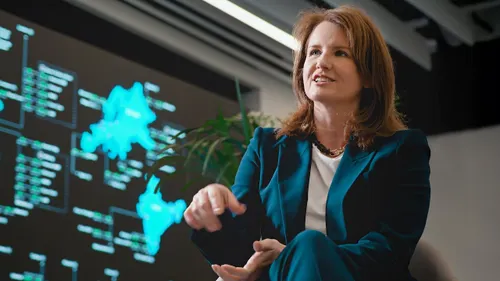
The Big Interview: BNY CIO Leigh-Ann Russell
Running cybersecurity for the world’s most successful military alliance is not for the faint hearted; there’s a target on NATO’s back and powerful adversaries are sniping at it. Mario Beccia stays focused through martial arts, music, and spending time with family.
Mental clarity is vital: He’s grappling with a set of challenges familiar to many enterprise CISOs, as his teams battle to keep NATO’s enterprise technology systems secure. Balancing innovation with security, modernising identity management and cryptography across a complex landscape, and communicating complex technical issues upstream to multiple stakeholders; many of whom are well-versed in kinetic conflict, but less so in its digital counterpart.
Mario is NATO’s Cyber Readiness and Operations Director, Cyber and Digital Transformation Division; a long title that also comes with a long list of hard-won responsibilities. (It’s arguably simpler to think in four letters: Over the past five years the Italian national has been working as Deputy CIO, Cybersecurity; effectively holding a CISO role for NATO’s enterprise IT systems, which serve some 30,000 alliance users.) He joined The Stack to talk us through his main pain points and priorities.
It has been nine years since NATO recognised cybersecurity as a domain of operations; far fewer since it started trying to bring some central coordination to its own cybersecurity and broader IT functions. (In 2021, for example, the multinational defence alliance hired its first CIO, with a mandate to deliver “coherence” across its 57 civil and military bodies.)
It is now restructuring how it delivers technology modernisation, and critically, supports cybersecurity – including via a new NATO Integrated Cyber Defence Centre (NICC) that its leaders announced in 2024.
NATO’s CROD, CDTD.
Beccia, an experienced enterprise architect rejoined NATO in early 2021, after three years as CISO of the European Defence Agency (EDA), where he helped build out a greenfield cybersecurity practice at the agency. (At NATO he has previously managed a range of key cybersecurity programs and enterprise architecture initiatives, including at NATO Communications and Information Agency and NATO Allied Command Transformation.)
Sitting down to chat with The Stack in Brussels, he’s happy to reflect on some of the hard-won successes of the past four years, including efforts to dramatically streamline technology procurement, but is also candid on the challenges that remain, as the alliance continues to prioritise more joined-up thinking among its members.
The Big Interview: NATO cybersecurity chief Mario Beccia
Goldman Sachs’ CIO Marco Argenti doesn’t describe himself as Chief Information Officer on LinkedIn (where he is “Engineer” instead), and despite being a partner at the investment bank and member of the management committee, gives the impression that he is ready to roll up his sleeves and start coding alongside Goldman’s 12,000+ technologists.
Maybe it’s a childhood spent tinkering with an HP-41 programmable calculator – “I built my first computer programme on an actual computer when I was 13; that was a very long time ago, by the way” he says drily – but sitting down to talk with The Stack in Goldman Sachs’ New York offices, Argenti still clearly retains a genuine enthusiasm for testing the capabilities of emerging technologies; including, yes, generative AI.