Technology Secretary Peter Kyle had high hopes for the new partnership. Image Credit: Google Cloud
A new partnership between Google and the British Government (HMG) will help rid public services of “‘ball and chain’ legacy contracts,” claimed the Department for Science Innovation and Technology (DSIT) this week – triggering an outcry in some quarters at the opacity of the agreement.
In a keynote at Google Cloud’s Summit on 9 July, Technology MinisterPeter Kyle said thepartnership would involve “much more collaboration” with Google’s DeepMind AI lab, and could see the company invest "hundreds of millions of pounds" as it explored next-generation technologies.
A DSIT release said the two would "explore the potential development of a single platform to monitor and respond to cybersecurity issues.”
The “partnership” triggered an immediate outcry in some quarters.
The Guardian, for example, drew a parallel between the announcement and an engagement between HMG and Palantir in 2020. (The latter initially provided services to the UK government for £1. In 2023 it then won a competitive £330 million contract to create a single NHS data platform.)
"Doesn’t comprise of [sic] any specific commercial agreement and sits outside of the Procurement Act"
A series of hyped promises left many unsure of what, precisely, the "partnership" entailed, and also prompted somecampaigners to accuse HMG of ignoring data sovereignty concerns by handing over UK public data to a US hyperscaler, a claim that appears unfounded on a closer look.
Pressed by The Stack in a series of emailsto clarify the precise nature the partnership, a government spokesperson affirmed that it “defines how we will work together going forward, but doesn’t comprise of [sic] any specific commercial agreement and sits outside of the Procurement Act.”
Any contract made following the agreement of this partnership will operate in full compliance with the Procurement Act 2023. In return for helping public sector organisations move away from ball and chain technology, upskilling civil servants, and sharing technical expertise from Google DeepMind – Google’s position as a strategic partner gives them a visible position in the public sector market, which allows government to shake up a supply chain by bringing increased choice and competition.”
A little jab at AWS reliance?
AWS absolutely dominates cloud deals won through G-Cloud.
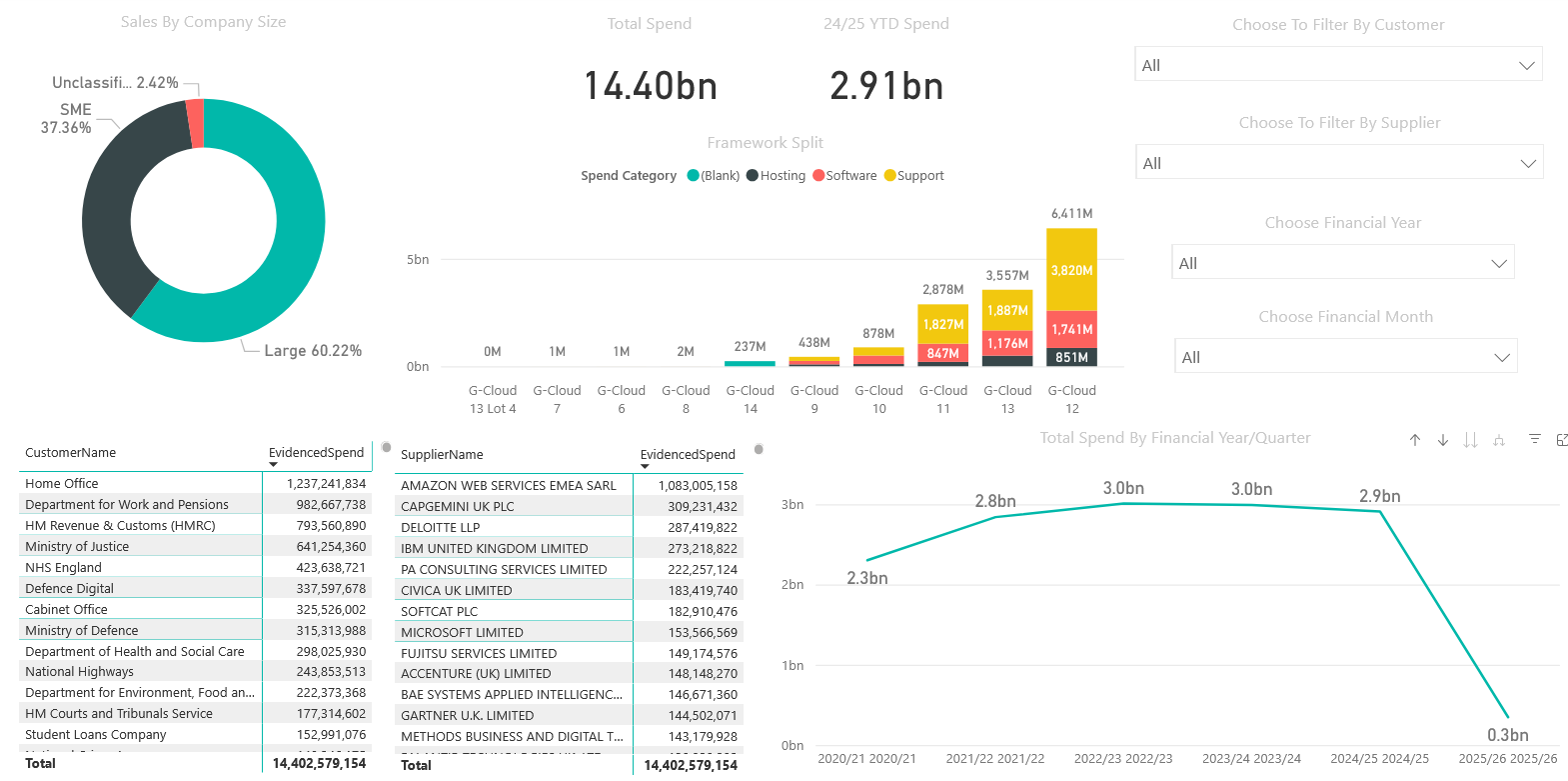
Google Cloud has a hugely limited footprint in UK government technology circles, where AWS dominates as the cloud provider, public datasets show.
Under the G-Cloud 13 procurement framework, for example, “Google Cloud EMEA” has landed £1 million of work and “Amazon Web Services EMEA” £365 million. Under the earlier G-Cloud 12 framework, AWS landed £527 million in central government work and “Google Ireland Ltd” £7 million.
AWS has also hired numerous former senior government leaders over the years, including (among numerous others) former Cabinet Office CTO Liam Maxwell, who is now AWS’s “Director, Government Transformation”, and longstanding GCHQ/NSCS technical director Dr Ian Levy, who is now a distinguished engineer at Amazon. (All have, of course, stringently adhered to the guidance of the Advisory Committee on Business Appointments.)
Training? It's voluntary, online, free...
Another central aspect of partnership, Google Cloud's promise to upskill 100,000 civil servants by 2030 without cost to the taxpayer, still appears thin though, constituting only early commitments to tailor content through its existing freeSkills Boost platform.
Google Cloud told The Stack that while Skills Boost has held in-person sessions before, there were no agreements to bring anything offline for the public sector, and DSIT clarified that the training would be offered on a voluntary basis with no requirements for civil servants.
Training the civil service is vitally important if HMG is to deliver on its ambitions to double its number of digital expert workers, and have one in ten civil servants working in tech roles by the end of the decade.
Notably though, thegovernment's response to a parliamentary committee investigation into its use of AI, released the day after Kyle's speech, outlined a more promising plan.
It highlighted new talent pipelines and cross-sector initiatives such asTechTrack and theAI Accelerator Programme, and said all public sector executive committees will be required to include digital leaders, with the government's Chief Digital Officer given more power to influence "key decisions."