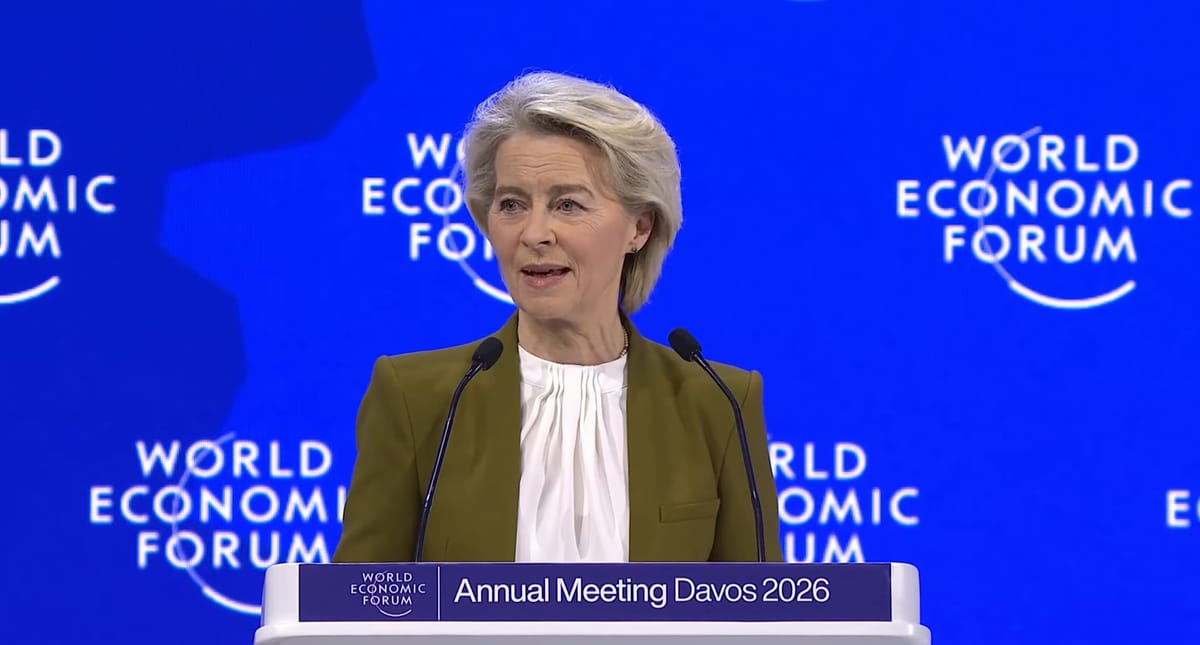
The European Commission plans to propose a company structure called “EU Inc” that would create "a single set of rules” anywhere across Europe.
EU President Ursula von der Leyen said that “as it stands, too many companies have to look abroad to grow and scale up – partly because they face a new set of rules every time they expand into a new Member State."
Her comments came in a speech that warned "Europe must speed up its push for independence... there is now a real consensus around this."
Speaking at the World Economic Forum in Davos, von der Leyen said that EU Inc, also known as the 28th Regime in Brussels, would let new businesses register themselves in 48 hours for operations in any of the EU's 27 member states, with a standardised EU-wide rulebook governing their finances.
“If we get this right – and if we move fast enough – this will not only help EU companies grow. But it will attract investment from across the world.”
“An urgency mindset”
The proposal is one of several being put forward by the Commission with an “urgency mindset” – von der Leyen also highlighted the need to create a deeper and more liquid capital market, and more competitive energy market if the EU were to attract investment and regain competitiveness.
Whether on trade or business, capital or energy – Europe needs an urgency mindset. Our starting point is good. We are home to global champions in fields ranging from wind power to next-generation batteries.
From aerospace to the industrial machines that are essential to build chips or advanced weapons. Our companies are taking up AI at the same pace as their US peers. Europe is in the race for the key technologies of tomorrow. “But as global competition gets ruthless, we must show real ambition – especially in those sectors vital for our independence” - von der Leyen
EU Inc
The plan for a uniform, continent-wide company structure and set of rules, comes after a year of lobbying by industry group EU-INC, which presented a petition with 13,000 signatories, including from the CEOs of Lovable, Stripe, Revolut Europe and Mistral, to the body in early 2025.
Tom Henriksson, General Partner at VC firm OpenOcean said it "will, if implemented correctly, at long last put startups on equal footing with overseas competitors" by slashing registration time from months to days.
He cautioned, however, that “the result may be just another layer of bureaucracy, and founders potentially shouldering compliance costs in the countries that do adopt it, without feeling the benefits. Only time will tell whether adoption is widespread enough to avoid this fate."
The EU startup problem
The EU's issues with retaining homegrown startups is well covered. Many of its biggest success stories, such as Spotify and Stripe, moved to the US for their IPO. Crunchbase data shows European startups raised $13.1 billion in Q3 2025, compared to the $40.5 billion by North American startups.
According to a 2025 Startup Ecosystem index from StartupBlink, only one EU city ranked in its global top 10, Paris (which comes in eighth.)
The EU itself has also criticised the status quo.
During a talk at Finnish startup conference Slush, EU Tech Commissioner Henna Virkunnen said the body had been "too slow and too bureaucratic" for local tech businesses and praised the EU Inc initiative.
A European Investment Bank study released January 12 also found complex regulations, a lack of investment, and disjointed support were the primary issues for startups in the EU. Its recommendations also included a pan-European legal entity.
Industry reacts
Investor Christian Schmidt said online the scheme "would be massive step forward for the EU" if it aligned with the ideas proposed in the EU-INC petition.
Nicolai Droll, startup development lead at German startup accelerator CyberLab, said the proposal was a "serious step towards becoming more flexible, faster and more entrepreneur-friendly" that could enable Europe to compete with the US and Asia.
However, not all are convinced, with StartupBlink CEO Eli David Rokah commenting before Von der Leyen's speech that a pan-European entity could "force small, innovative countries to operate like the laggards and slower countries."
The link has been copied!