The Big Interview: Nationwide's Group COO Suresh Viswanathan
“You can't be a COO in the 21st century and not be ‘tech major’, ‘ops minor’

“You can't be a COO in the 21st century and not be ‘tech major’, ‘ops minor’
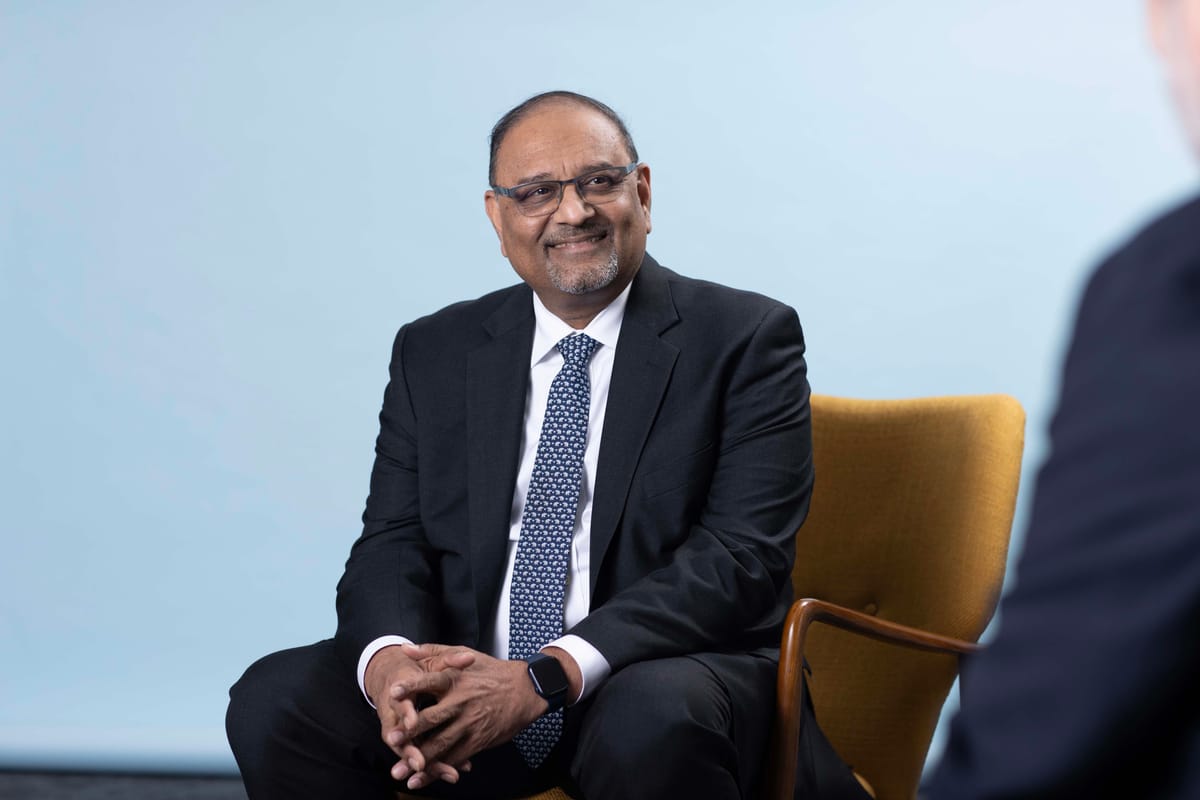
The Stack is resurfacing some of our favourite "Big Interviews' from 2025 as we close off the year. This piece first appeared on September 3.
“There’s a lot of hype,” reflects Nationwide COO Suresh Viswanathan: “You know, [solving] world hunger, cancer; there's a way to go on that...”
Viswanathan is, of course, talking about generative AI (what else).
He’s commendably frank about what it can’t do yet.
That includes magicking away technical debt, despite a shiny wealth of products and services from consultancies, hyperscalers and SaaS vendors alike that suggests it can: “We’re not relying only on LLMs” he tells The Stack, referring to how Nationwide is using voice analysis in its call centres.
This seems particularly pertinent given the COO’s ongoing platform modernisation efforts at Nationwide – the world’s largest building society.
Nationwide first opened its doors in 1884. Like most storied financial service firms, it has a wealth of “legacy” systems and has been undergoing a major digital transformation under Viswanathan’s leadership.
Viswanathan says bluntly that when he joined three years ago his initial assessment of Nationwide’s technology landscape would have put it “in the bottom half of most league tables".
“Technology modernization takes time, it doesn't happen in an instant,” he says – it is often a case of “unwinding the combined intellectual property of the firm over 20, 30 years… Despite all the cool talk you hear in the press about GenAI and how you migrate from old to new, the reality on the ground is it takes a lot of hard yards for us to move”, the COO adds.
Nationwide has been in “catch-up mode” he admits, as it modernises operations, improves cyber resilience, and optimises digital experience for the seven million customers that log on to its platforms every day.
That’s all starting to pay off: Nationwide’s Group CEO Debbie Crosbie hailed an “outstanding twelve months” in its most recent annual report, with the company posting a 30% jump in annual profits – and cited the addition of “over 30 new features and improvements across the Nationwide and Virgin Money personal banking apps,” in her roundup.
We’re talking about technology with Nationwide’s COO in large part because he holds the technology leadership position; there’s no CIO.
“You can’t be a COO in the 21st century and not be ‘tech major, ops minor’”, Viswanathan (who joined Nationwide in 2021) tells The Stack.
He adds, potentially controversially (although Lloyd’s Banking Group’s COO feels somewhat the same way) that “having a CIO means that the COO is sort of compensating for a lack of knowledge about technology.”
So what is the state of play for Nationwide’s infrastructure?
In terms of infrastructure, some 40% of the company’s applications are now running in the cloud, though he estimates around 70% of all transactions are still processed on-premise. A new payment platform will be “probably six times faster” when it launches in September, he adds.
“A key part of our journey this year is to run ourselves [with] one leg on-premise and one leg in the cloud concurrently” Viswanathan says, “that’s the journey we are pushing towards… so we are shifting gears.”
The new payment platform is a good example of this, it will run simultaneously on two cloud providers when it launches, improving resilience in the event of a total cloud outage and other IT hiccups.
The issue is particularly prescient in light of a Treasury Committee investigation into banking IT outages in the UK, which revealed Nationwide had seen 18 outage incidents since the start of 2023 totalling 70 hours of at least partial downtime; it was not alone in resilience issues.
Viswanathan says Nationwide will likely be the first in the UK to operate a dual cloud platform, though the idea is at least similar to Monzo’s Stand-In banking system it runs not as active-active multicloud systems but completely different and independent stacks for streamlined failovers.
For Nationwide’s platform, the group opted for Azure and AWS as its primary cloud partners in a choice that the COO says was “horses for courses” as “all have their benefits.” The move to the cloud has been supported by regulators he says, and though he knows “people who have a whinge about it”, it has been a “very constructive partnership.”
“Our objectives are actually aligned… what we hold ourselves to account on is disaster recovery, business continuity, [and] the regulators represent our customers in the room by asking us exactly the same question.”
Another particularly fruitful change Viswanathan made was to consolidate the group’s observability software stack. The building society’s teams had spun up a mix of overlapping vendors; app Dynamics for on-prem, Elastic for the cloud, Datadog on AWS for the contact centre…
“That was part of the fatal flaw in the organisation,” says Viswanathan.
“Everyone is proud of their individual tool, but it doesn’t join up through the customers eyes and reaction times are everything [if something fails]. Half the battle is won if your teams are mobilised to react using the same insight and information, [but] we could not demonstrate that years ago,” the COO adds.
To address the issue, he drew from lessons at TSB, where “budgets were limited but our ambition was not” and the company was struggling after a bungled banking system migration hit performance prior to his arrival.
“Dynatrace was a game-changer for me in that situation… the telemetry that [it] provided us meant that we could get to resolution faster than any other method of finding out where the actual problem lay,” he recalls.
He subsequently went to competitive tender at Nationwide and brought in the application performance monitoring firm to help “join the dots inside the organisation… ‘is it the firewall, is it the server, is it the app, is it the network?’”. He’s made other software investments too, of course.
“There’s no compromise on availability, disaster recovery, business continuity plans. All of those are critical elements [so while] the observability tells you where the problem is, you still need to take action. We’re not yet in a self-healing world, as much as we’d like to be there.”
Nationwide has invested in immutable backups “so we’re ready for ransomware attacks”, as well as tools like HPE’s Zerto to maintain a “high availability disaster recovery.” (Nationwide runs a large private cloud…)
With a new payment platform “nailed on” for its September release (Form3 running in AWS, built with input from Accenture) and a digital hub now up and running to improve features on the Nationwide app, the COO has now set his sights on the “big data problem” – and breaking down entrenched data siloes across software and organisational functions.
“None of these organisations have all of [their data] joined up to make meaningful insight or intelligence,” Viswanathan says, confessing that at Nationwide “we have so much data that we’ve not bothered actually."
Talking of cybersecurity, IT Ops, and vendors, he’s off:
“It's not like the observability tool runs on its own. If you were able to join it up with the vulnerability data from Qualys and the ServiceNow ticketing and the telemetry from your SOC, God, we'd be so far ahead, right?
"That's the opportunity that we have. Every large organization has a whole bunch of IT partners they work with, right? If you look at the top 10 tools in this space… there aren't like 5,000 permutations. What we are trying to do is to bring focus to the topic, figure out who are the experts.
“So, for example, IBM are acquiring a lot of capabilities that helps with IT ops. So they've bought HashiCorp, they've bought Ansible, they've done a whole bunch of portfolio acquisitions, which they are joining up. So they're one of the partners that we're talking to. There are others [that] may not have software platforms, but they have the aptitude and the attitude to go and join these things up,” he says, driving home the importance of competent partners in finding solutions to transformation.
He’s “agitating” for action in the company here, he adds, because it “takes 12, 18 months before this thing [improved IT Ops] is of good quality.”
Another huge project for Nationwide is the integration of its newly acquired subsidiary Virgin Money, bought for around £2.8 billion in October 2024 and including assets later valued at £5.1 billion.
Nationwide management has made no secret of the fact it will be dropping the Virgin Money brand, with CEO Crosbie also earlier stating the company would undergo a “Part VII” transfer process in 2026 to move all Virgin Money business to Nationwide. Viswanathan says it is “very early” on in the integration of the company’s tech stack.
Pressed further though, the group COO says his approach is “camp on customer first” and figure out “how they consume various elements of Virgin Money”, from daily banking to savings accounts and mortgages.
“We need to make sure that we’re not inconveniencing them” he says, “in some cases it might just be easier to move customers across to the Nationwide stack … [but] there are some things we could think about converging over the top”, though he cautions “we’re taking our time around that analysis.”
In the meantime, Viswanathan is, to no surprise, turning to AI to address some of his problems and working through the “noise to signal ratio” on its benefits. As you’d expect, he does see potential in the technology, but he says at the moment this is mainly “in co-pilot mode” as GenAI likely won't be used “in autopilot” at Nationwide “for the foreseeable future.”
Existing use cases at the company include in its ‘QAQC process’, where a GenAI machine listens back to 30% of customer calls to analyse Nationwide staff performance, and in customer support, where a response letter is generated using AI before a human steps in to “eyeball it before sending it off.”
When it comes to building Nationwide’s AI tools, the company has stayed “largely in-house”, “we’re not relying on LLMs” he says, though the building society has invested in fintech startups to address solutions they haven’t found elsewhere.
Citing the call listening AI tool, Viswanathan says “you would have thought Amazon would have cracked that problem [but] turns out they haven’t…
“Then I went to Microsoft and said ‘you guys are the kings and queens of GenAI, can you do this for me?’ [But that service was] not available. So we started on the journey, fully recognizing at some point this use case makes so much sense for these two large actors. They will invest and we can retire our process, but we have to start somewhere…”
(Soon after this conversation between Viswanathan and The Stack, Aveni, a startup backed by Nationwide and Lloyds Banking Group, announced its FinLLM product, a model trained on financial sector-specific data to execute tasks such as flagging risky conduct during customer service calls.)
Stepping back from the immediate challenges and based on Viswanathan’s extensive financial services career (he reflects, harking back to the very start of his career as a young man in India, that he only took his first financial services role because it came with free accommodation) how have his experiences varied in executing digital transformation?
“First of all, this is like trying to win the Premier League.
“There are like 20 teams which are competing. The objective is the same, but what you're trying to do to win is different with each team, right?
“Every organization has a certain ethos, a certain culture, a certain style of football they'd like to play. If I can extend that analogy my job is, dare I say, the coach when I come in. We've got a team that's now well-established on how to get this done. We learned a lot, for example, at TSB, through the crisis, because we're all learning to work differently.
“Our ability to construct partnerships with external actors is something that we picked up as a big muscle only in TSB. We didn't have it in Barclays, even though we had deep pockets in that organization. And so we built that muscle up, and having come in here, we've been able to redeploy that muscle with a much more experienced team.
We have a playbook. Although the pitch is not the same, the weather is not the same, all those things are different… But we've got a good playbook now on how to transform, and hopefully at the end of Virgin, also how to integrate!”
Interviews, insight, intelligence, and exclusive events for digital leaders.
No spam. Unsubscribe anytime.