

Welcome to Runtime! Today: Microsoft and Google's earnings digested; London Stock Exchange Group’s CTO on who owns AI spending; the neoclouds are staring down some dark clouds on the horizon, and more.
Please forward this email to a friend or colleague! If it was forwarded to you, sign up here to get Runtime for free every week, or level up here.
Stocking up: Measuring a return on all that enterprise AI spending is harder than a lot of CFOs would like, and LSEG CTO Ken Beinert is trying to find a balance. "I think the most important part of pricing AI-based solutions is to make sure we understand the business case upfront, and that we do very thorough evaling for quality and cost ahead of time, so we do understand the unit economics," he told J.R. Storment.
Delivered in partnership with the Tokenomics Foundation.
First up: Kerching!
The biggest winners of the enterprise AI era continue to be the cloud providers, who benefit not only from the insatiable demand of AI model companies for compute, but also from the FOMO of enterprises that want to jump into AI but need help - and perhaps, just sometimes, a nudge to burn committed spend. While AWS won't join the party until later today, Microsoft and Google earnings showed robust cloud + AI growth.
Google Cloud actually managed to double revenue compared to the same period last year, which is an incredible amount of growth on what was already a sizable number. "Google Cloud now has 18 product lines, with more than $1 billion each in annual revenue," CEO Thomas Kurian said.
 Tom Krazit

Meanwhile, Microsoft posted a 48% gain in Azure revenue during its first fiscal quarter of the year, disclosing the quarterly figure ($33.2 billion) for the first time after finally bowing to years of calls for greater transparency in its most important division. Microsoft reported $677 billion in backlogged revenue, compared to Google Cloud's $561 billion.
One of Redmond's big boasts, as it continues to push hard on its own frontier model and SLM mix alike: "We recently completed pretraining MAI-Base-2, which outperforms other open weight models we tested with 4 to 12x greater training compute efficiency. This base model will be used in the upcoming MAI models across thinking, code and cyber."
The hard numbers, below.
 Yaël Bizouati-Kennedy

The rest of The Stack
Stormy weather: It's been a rough couple of months for the neoclouds, the AI cloud providers hoping to carve out some space for themselves amid the hyperscalers. “Winners have power, contracts, and flexible capital; everyone else consolidates or dies on the debt clock,” Terence McMenamin, co-founder of Techdollar, told The Stack.
 Yaël Bizouati-Kennedy

Dedicated follower of fashion: As the apocryphal line about robbing banks goes, "that's where the money is." Hackers are increasingly targeting fashion industry companies that have an enticing combination of wealthy customers and outdated security technology, with the ASOS breach earlier this month serving as just the latest example.
 Tom Matsuda

RAMming speed: Don't expect to see an end to the memory chip shortage this decade, according to SK Hynix executives. The company plans to ramp up production as much as possible over the next year, but it is otherwise content to watch its revenue surge an astonishing 328% compared to last year.
 Yaël Bizouati-Kennedy

Push stars: It has been a rough year for GitHub, which struggled under the weight of demand for its services generated by coding agents. But those struggles should be put in perspective: Users of the platform have committed code to GitHub 17.9 billion times so far this year, which is more than the last two years combined.
 Yaël Bizouati-Kennedy

Stacked up — The week ahead
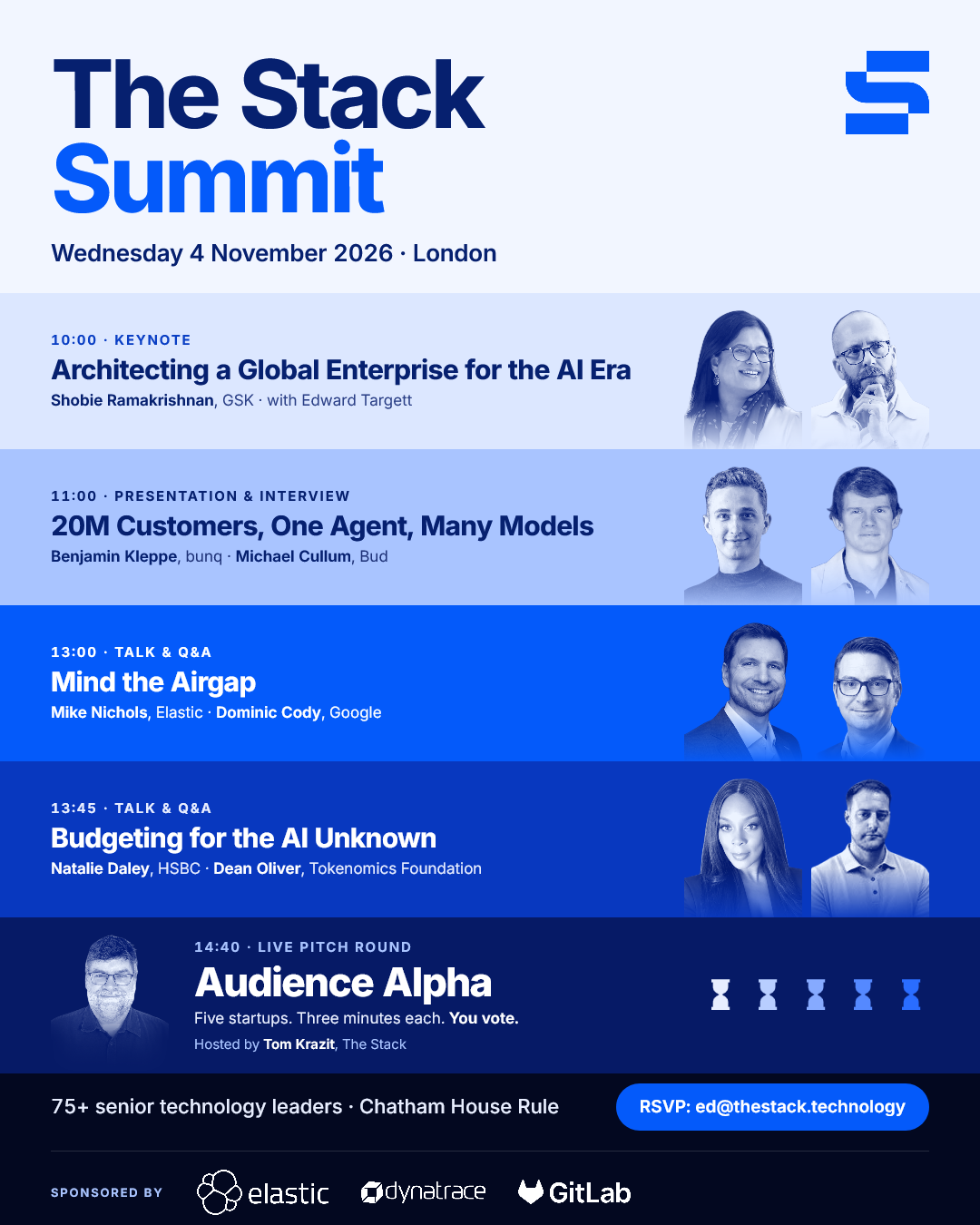
The Stack Summit brings 75 technology leaders to an informal, Chatham House rule gathering in London on Wednesday.
Bloomberg Tech will be in London starting Monday, with speakers from Cohere, OpenAI, and Salesforce expected to attend.
AMD is scheduled to report earnings on Tuesday, with analysts looking for $13 billion in revenue, which would be a 41% jump.
WSJ Tech hits Napa Valley Tuesday and Wednesday, with OpenAI President Greg Brockman headlining the list of speakers.
We're also reading
AWS SDEs get told: Amazon has told its army of engineers that “if your work does not benefit from current AI tooling, that is a finding, not a failing” – in a closely scrutinised missive to staff on on the role of the developer in the age of AI. Gergely has his own reading...
Killing the coding rounds? Anthropic Felix Rieseberg explains why he's not doing coding interviews any more.
Neocloud sweat: The credit story behind the fear, from Bain Capital's Saanya Ojha.
Kernel mustard: Infosec chatter is spiking around this 9.8 UAF vulnerability in the Linux kernel’s IPv4 TCP stack. Ubuntu's advisory is here; Red Hat's is here. It looks to mostly result in DOS and we're not yet persuaded by the hype. We're still investigating. Thoughts welcomed > ed@thestack.technology
Want to partner with The Stack? You can both support our independent journalism, and get in front of a large and influential audience by workign with our commercial team. We offer Runtime sponsorship slots, multimedia storytelling, and private events. Our biannual Stack Summit returns to NYC on April 28. Get in touch for a deck and to learn more.