

Welcome to Runtime! Today: Our coverage from the Open Source Summit in Prague suggests that simply switching to open-source software won't free European companies from US influence, a call for transparency when scanning books for AI training, and more.
Please forward this email to a friend or colleague! If it was forwarded to you, sign up here to get Runtime for free every week, or level up here.
First up: Time to build
It's understandable why the European Union has encouraged its members to diversify their tech stacks away from US companies given everything that has happened in the US over the last decade. But while switching to open-source software might allow those companies to feel like they're participating in a global system, guess where most things open source are built and nurtured these days.
"Europe is not necessarily strategically investing in the governance of those open ecosystems, and so from the outside if you look at those ecosystems, they are going to be dominated by companies from the US and from China," Linux Foundation Europe general manager Thierry Carrez told The Stack in an interview at the Open Source Summit. According to a report released during the event, only 37% of European groups contributed to governance work, making up just 15% of overall governance participation.
 Noah Bovenizer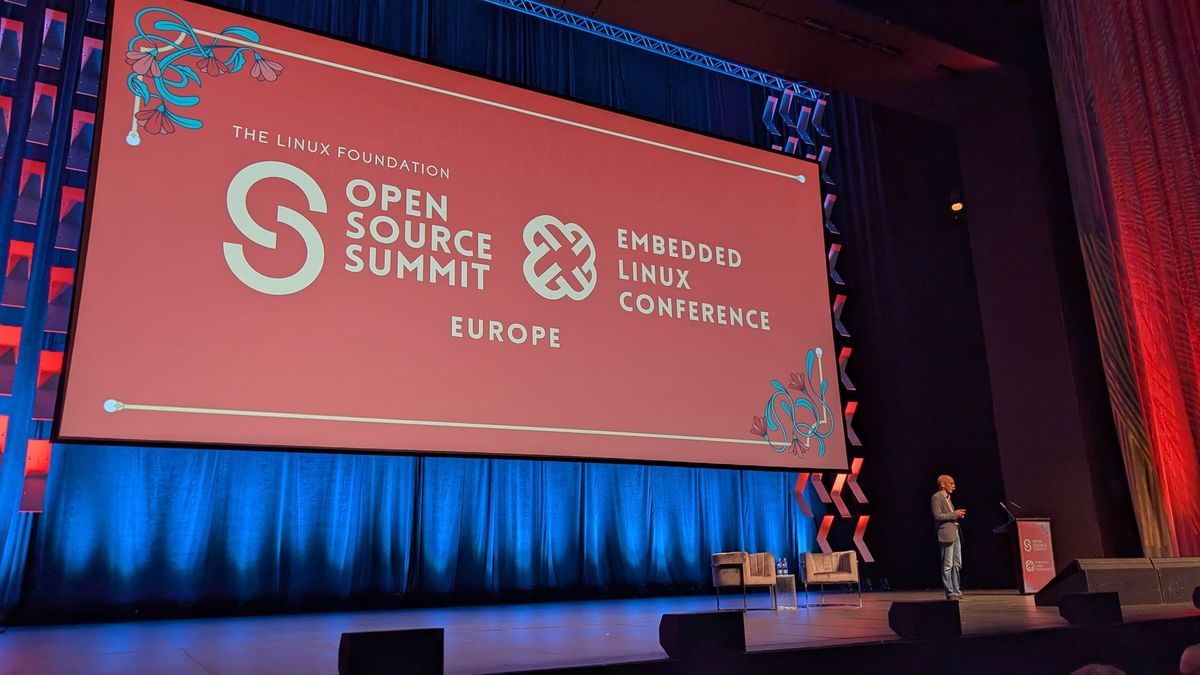
That is not a sustainable state of affairs for a continent that would like to carve out its own tech stack, especially given how many US (and increasingly Chinese) developers working for tech companies are paid by their employers to contribute to open-source projects. However, according to Carrez, the EU is making progress encouraging the private sector to step up its game, which is not always a strategy you see coming out of Brussels.
It's a lesson that took US enterprise tech juggernauts like Microsoft and AWS years to learn, but the only way to shape the future direction of the open-source movement is to participate, early and often. "If you don't talk to the people that are building the technology that you're using, then it's just another dependency,” Carrez warned.

ISO 27001 is the globally recognized standard for information security — and the credential often required by European customers, governments, and regulated industries. This checklist maps every step, from building your ISMS to passing your certification audit.
Whether driven by a customer request or a proactive security push, you'll have a clear picture of exactly what to tackle and when with this checklist from Vanta.
The rest of The Stack
Open and shut: Open models have been the talk of enterprise tech this year as closed-model costs have increased inline with their capabilities, but it's been a little tricky to understand how much of that talk has translated into action. Nutanix was willing to put some numbers behind its open-model strategy on Wednesday: it plans to move 80% of its AI workloads to open models over the next year using a homegrown AI gateway to play traffic cop.
 Adam Hobart-Williams
Burst mode: Bitvavo, a Dutch cryptocurrency exchange, needs infrastructure that can handle unpredictable spikes in traffic - the bursts that come with major trades, or Elon Musk’s posts on digital currencies - while fulfilling strict European Union regulations on financial platforms’ compliance and resilience. It uses a combination of Amazon Aurora on AWS and Kubernetes to make sure it can execute those orders. This interview was delivered in partnership with AWS.
 The Stack
Training transparency: As AI companies rush to digitize old or out-of-print books as part of their desperate search for fresh data, UK proposals for regulation designed to track how those companies are obtaining that data overlook the printed page. "While the industry insists it needs provenance and metadata for the data it wants, it provides neither for the data it takes," argued Elena Simperl of the Open Data Institute in this contributed piece.
 Elena Simperl
Key learnings: Valkey is making progress as an open-source alternative to Redis, but the fork's "original sin" made it harder for large applications to make the switch, according to Percona's Kyle Davis. The database company plans to release Valkey-proxy, which will make it easier to migrate large clusters, under the BSD-3 open-source license later this month.
 Edward Targett
Hungry like the wolf: It's a tale as old as time: During significant platform shifts, big established vendors find it hard to move at the speed of the upstarts trying to solve a specific problem without a legacy customer base to nurture. But what those vendors do have is money, and this week SAP bought TechWolf to add an AI context graph to its SuccessFactors HR software.
 Noah Bovenizer
The Stack Summit: We're convening in London on November 4-5, for a series of exclusive workshops and fireside conversations on the rise of BYOC as a favoured enterprise SaaS deployment model; how many CDOs are consolidating their data estates with Apache Iceberg; how CISOs at FTSE 100 scale are handling supply chain risk (with GSK's CISO) and more.
Ticket applications are subject to pre-vetting. Get in touch with ed@thestack.technology if you want to be in the room.
Stacked up: The week ahead
InfoSec World kicks off Monday in Orlando, featuring a keynote interview with acting CISA director Nick Anderson that afternoon.
Workday Rising will be in Las Vegas Tuesday through Thursday, as the HR software company looks to show off how it is transitioning into the AI era.
Capacity Europe takes place Tuesday through Thursday in London, bringing together telcos, networking infrastructure companies, and cloud providers to talk about the AI buildout.
Semicon West hits San Francisco Tuesday through Thursday, showcasing the latest in chip manufacturing and design strategies.
Speaking of chip manufacturing, ASML and TSMC report earnings on Wednesday and Thursday, respectively.
Vercel Shift will be in San Francisco on Thursday, featuring an opening keynote from CEO Guillermo Rauch and speakers from Anthropic, AWS, and Clickhouse.
We're also reading:
Margaret Hamilton, computing pioneer who led software development for the Apollo program, dies at 90: The definitive remembrance of a computer science legend.
Thanks for reading — see you Saturday!